
Mastering IELTS Writing Task 2 Double Question Essays: The Ultimate Band 9 Strategy Guide
Among all the essay types encountered in the IELTS Academic and General Training Writing modules, the Double Question Essay (often referred to as the Direct Question Essay or Two-Part Question Essay) stands out as unique. While opinion essays or discussion essays require you to balance opposing viewpoints, the double question prompt asks you to play detective and answer two entirely distinct queries based on a single background statement.
Many candidates find themselves overwhelmed by this format because they fail to properly allocate space or structure their ideas cleanly. If you fall into this trap, your score for Task Achievement and Coherence can plummet rapidly. In this premium guide, we will unpack the exact blueprint required to construct a flawless, high-scoring essay that hits every band descriptor with clinical precision.
Anatomy of a Double Question Prompt
Before putting pen to paper, you must confidently recognize this essay variant. A typical double question task features an introductory observation followed immediately by two clear questions. Here is a realistic blueprint:
"In many nations, traditional physical retail stores are declining as e-commerce grows exponentially. What are the main drivers behind this change? Is this a negative or positive shift for society?"
Notice that the task does not ask you to "discuss both sides and give your opinion." Instead, it demands that you explicitly resolve two specific issues: the root causes of retail decline and a qualitative judgment of its societal impact. Missing either component guarantees that you cannot score above a Band 5 or 6 in Task Achievement.
The Golden 4-Paragraph Structure
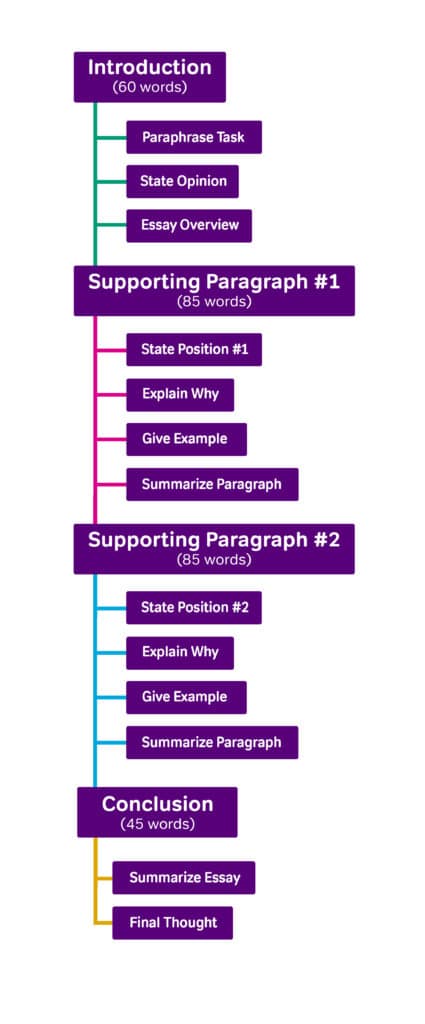
To maximize your marks for Coherence and Cohesion, you should stick rigidly to a pristine four-paragraph architectural layout. This setup distributes your word count perfectly and keeps your ideas mathematically organized:
- Introduction (40–60 words):
- Sentence 1: Paraphrase the background prompt using sophisticated synonyms.
- Sentence 2: Thesis statement that cleanly highlights your concise answers to both questions.
- Body Paragraph 1 (90–110 words): Address the first question exhaustively. Start with a clear topic sentence, elaborate with analytical detail, and cement your logic with a concrete example.
- Body Paragraph 2 (90–110 words): Address the second question with the identical structural rigor used in the previous section.
- Conclusion (45–60 words): Synthesize your main points. Reiterate your answers to both questions using alternative vocabulary without introducing novel configurations or ideas.
Step-by-Step Writing Workflow with a Live Sample
Let's work through a practical example to observe this blueprint in action. Consider the following prompt:
"Many people choose to postpone starting a family until later in their professional lives. Why is this trend becoming popular? What are the implications for child development?"
1. Crafting the Perfect Introduction
Your introduction sets the expectations for the examiner. Do not copy the prompt word-for-word; rewrite it creatively. Then, add an explicit thesis roadmap.
Sample Intro: "In modern society, a growing proportion of individuals deliberately delay parenthood until they have advanced significantly within their careers. This phenomenon is primarily driven by the pursuit of financial stability and professional growth. Ultimately, while this shift provides children with robust economic security, it can simultaneously result in structural developmental challenges due to generational age gaps."
2. Developing Body Paragraph One (The "Why")
This paragraph must answer the first question exclusively: Why is this trend popular? You should aim to use sophisticated transitions to bridge your thoughts smoothly. For a deep dive into advanced linking strategies, review our guide on IELTS Cohesive Devices and Band 9 Linking Phrases.
Sample Body 1: "To begin with, the primary catalyst behind the postponement of childbearing is the highly competitive nature of the contemporary corporate landscape. Young professionals frequently feel compelled to dedicate their early adulthood to securing specialized qualifications and establishing a firm foothold in their industries. Consequently, establishing a family is deferred until a reliable baseline of financial independence is attained. For instance, recent socioeconomic data from Western European institutions indicates that the average age of first-time mothers has risen to thirty-two, correlating directly with increased female participation in tertiary education and demanding executive roles."
3. Developing Body Paragraph Two (The Implications)
Now, shift your focus fully to the second question: What are the implications for child development? Ensure your tone remains completely academic and analytical.
Sample Body 2: "Turning to the consequences, this shift exercises a multi-faceted impact on child development. On the positive side, mature parents generally possess greater psychological resilience and substantially greater economic resources, ensuring that offspring gain access to premium educational opportunities and supportive environments. However, a notable drawback involves potential generational disconnects. Older parents might struggle to participate actively in physically demanding childhood recreation, which can occasionally induce feelings of social isolation or limit the child's engagement in active, kinetic lifestyle habits."
Applying Essay Planning to Real-World Case Studies
The best way to develop analytical depth for Writing Task 2 is to practice dissecting real-world socioeconomic developments. Modern state initiatives provide exceptional context for analyzing causes, effects, public reach, and administrative impacts.
For instance, examine how you would evaluate government subsidy models or expatriate economic frameworks if presented in an essay prompt. You can review active real-world frameworks to study their socioeconomic targets:
Analyzing public transportation trends and direct student subsidies is a highly frequent essay prompt topic. Study how targeted infrastructure relief affects green logistics through this national active portal example.
Maryam Nawaz Electric Bike Scheme 2026 Apply Online →When writing about global economic migration, financial asset building, and remittances, look into real-world banking and auto finance structures built to leverage foreign-exchange resources.
Roshan Apni Gari Scheme 2026 Apply Online →Comparing Double Question Essays to Other Task 2 Formats
Understanding where this essay type sits relative to other prompt varieties can help you avoid mixing up your structural approaches on exam day. The table below breaks down the key structural nuances:
| Essay Variety | Core Goal | Body Paragraph 1 Focus | Body Paragraph 2 Focus |
|---|---|---|---|
| Double / Direct Question | Answer two distinct queries. | Comprehensive response to Question 1. | Comprehensive response to Question 2. |
| Agree / Disagree | Defend one explicit viewpoint. | First supporting reason for your position. | Second supporting reason for your position. |
| Discuss Both Views | Evaluate two separate opinions unbiasedly. | Analyze and unpack Perspective A. | Analyze and unpack Perspective B (plus your view). |
Crucial Lexical Resources for High Band Scores
To reach Band 7 or above in Lexical Resource, you must avoid basic vocabulary. Use academic alternatives and precise collocations instead:
- Instead of saying "causes": use underlying catalysts, principal drivers, structural roots.
- Instead of saying "results/effects": use profound ramifications, multi-faceted implications, downstream outcomes.
- Instead of saying "good thing": use advantageous phenomenon, progressive development, socio-economic boon.
Educational Video Walkthrough
Visual learners can review the video guide embedded below, which breaks down real-time prompt analysis and planning strategies for direct-question writing tasks:
For official assessment guidelines, test-day rules, and official scoring rubrics straight from the source, ensure you regularly visit the public descriptors on the Official IELTS Website.


Comments