
Minimum IELTS Score for Canada PR vs Australia Immigration Guide,
Minimum IELTS Score for Canada PR vs. Australia Immigration: The Complete Blueprint
Updated for the 2026-2027 Immigration Landscape
Navigating skilled migration pathways to economic powerhouses like Canada and Australia often hinges on a single, critical variable: your English language proficiency. Both nations heavily prioritize language competency because data continuously proves that immigrants who speak fluent English integrate into the local workforce significantly faster.
If you are mapping out your strategy, the International English Language Testing System (IELTS) General Training module is your primary gateway. However, understanding the absolute minimum score required versus the competitive score necessary to actually secure an invitation to apply (ITA) are two entirely different things. Let's break down exactly what you need to clear the baseline and maximize your immigration points.
1. The Crucial Distinction: IELTS General vs. Academic
Before registering for your test, you must select the correct module. For permanent residency, economic streams, and skilled independent visas, both Canada and Australia strictly mandate the IELTS General Training test.
While the Academic version measures language skills suited for an academic environment, the General Training variant focuses on basic survival skills in broad social and workplace contexts. If you accidentally take the Academic version for your PR application, your scores will likely be rejected by immigration authorities, requiring a costly and time-consuming retake.
Conversely, if your initial goal is studying abroad before transitioning to a permanent visa, your institutional requirements will focus heavily on Academic modules. To learn more about university guidelines, check out our insights on IELTS requirements for US universities or explore how language proficiency shapes paths in other major study destinations via the comprehensive Study in UK 2026 Hub Guide.
2. Canada PR: The Express Entry System and CLB Demystified
Canada manages its skilled economic migration primarily through the Express Entry system, alongside various Provincial Nominee Programs (PNPs). Within Express Entry, your language scores are converted into a standardized system known as the Canadian Language Benchmark (CLB).
The Express Entry pool operates on the Comprehensive Ranking System (CRS), a point-based grid out of 1,200 points. The higher your CLB level, the more CRS points you collect. Let's look at how IELTS maps directly to these critical benchmarks.
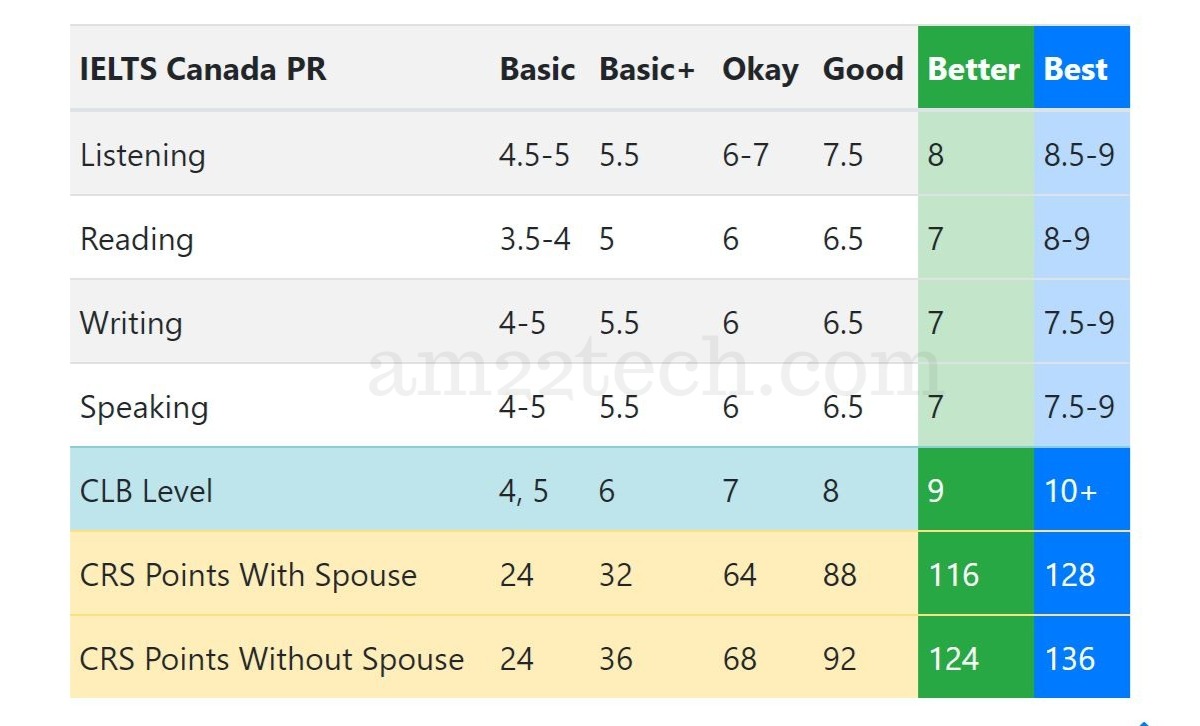
Visualizing the relationship between IELTS bands, Canadian Language Benchmarks (CLB), and corresponding CRS points.
The Absolute Minimums for Express Entry
To even qualify to submit a profile under the core Express Entry streams, you must hit a specific baseline depending on the program category:
- Federal Skilled Worker (FSW): A minimum of CLB 7 in all four language competencies (Listening, Reading, Writing, Speaking). This maps cleanly to a straight 6.0 in every single IELTS band.
- Canadian Experience Class (CEC): For NOC TEER 0 or 1 jobs (managerial/professional), you require a CLB 7 (IELTS 6.0). For NOC TEER 2 or 3 jobs (technical/trades), the requirement drops to CLB 5, which means an IELTS score of Listening 5.0, Reading 4.0, Writing 5.0, and Speaking 5.0.
- Federal Skilled Trades (FST): Requires a minimum of CLB 5 for Speaking and Listening (IELTS 5.0), and CLB 4 for Reading (IELTS 3.5) and Writing (IELTS 4.0).
The "Golden Target": Why You Actually Need CLB 9
While an IELTS score of 6.0 allows you to enter the pool, it rarely grants you enough points to secure an Invitation to Apply (ITA) in standard, non-targeted draws. Because the pool is intensely competitive, serious candidates aim for the legendary CLB 9 tier.
Reaching CLB 9 unlocks massive bonus points under the "Skill Transferability" factors of the CRS grid, combining your high language ability with your education and foreign work experience to skyrocket your overall score.
| IELTS Component | CLB 7 (Minimum) | CLB 8 (Good) | CLB 9 (Optimal Target) |
|---|---|---|---|
| Listening | 6.0 | 7.5 | 8.0 |
| Reading | 6.0 | 6.5 | 7.0 |
| Writing | 6.0 | 6.5 | 7.0 |
| Speaking | 6.0 | 6.5 | 7.0 |
Notice the steep cliff for the Listening section. Landing a 7.5 in Listening instead of an 8.0 will leave you stuck at CLB 8, costing you dozens of points on your CRS score. This single benchmark is often the difference between staying in the pool indefinitely or migrating permanently to Canada.
3. Australia Immigration: The Points-Tested Skilled Visa Framework
Australia utilizes a points-tested immigration architecture managed by the Department of Home Affairs. Popular pathways include the Skilled Independent Visa (Subclass 189), the Skilled Nominated Visa (Subclass 190), and the Skilled Work Regional (Provisional) Visa (Subclass 491).
Unlike Canada, which features highly complex micro-variations across sub-bands to calculate your score, Australia categorizes language competency into clean, tier-based points structures. The absolute baseline required to legally log an Expression of Interest (EOI) is termed Competent English.
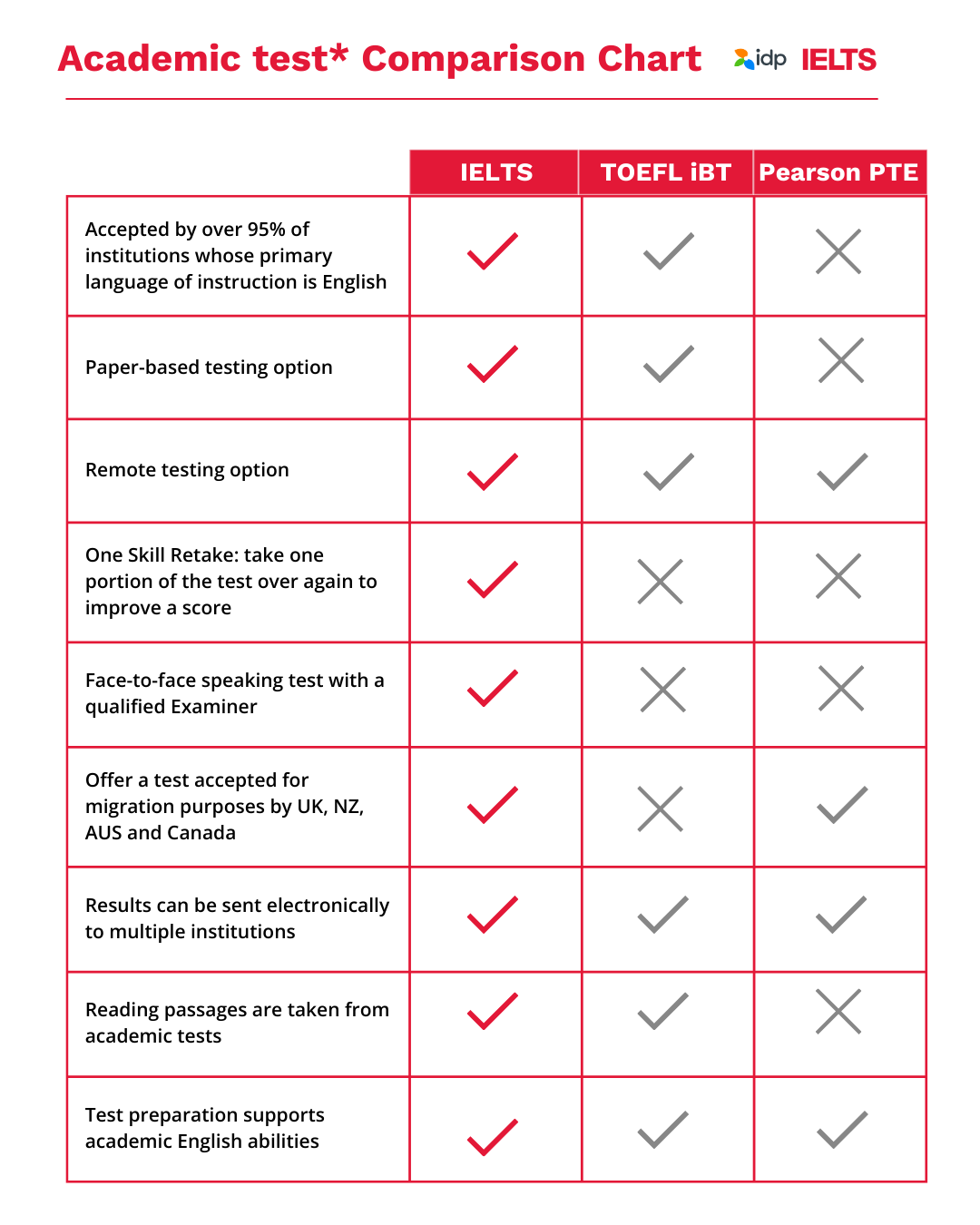
Reviewing language examination alternatives accepted across international immigration framework criteria.
Australia's Language Tiers Explained
The Australian immigration points table explicitly rewards higher levels of English language mastery. Here is how your IELTS General performance converts directly into visa points:
- Competent English (The Minimum): Requires an IELTS score of 6.0 or higher in all four components. Landing a 6.0 across the board awards you exactly 0 points toward your EOI tally. It acts strictly as an entry gate.
- Proficient English: Requires an IELTS score of 7.0 or higher in all four components. Achieving this tier instantly awards your profile 10 points.
- Superior English: Requires an IELTS score of 8.0 or higher in all four components. Reaching this pinnacle tier adds a massive 20 points to your profile, practically guaranteeing you outpace standard applicants in your occupational group.
Crucial Warning for Australia Aspirants: Your score is determined by your lowest individual component performance. If you achieve a 9.0 in Listening, Reading, and Writing, but score a 6.5 in Speaking, your official categorization is capped at "Competent English," yielding zero points on your application. Consistency across all skills is mandatory.
4. Comparing the Landscapes: Which Destination is Right for You?
When weighing your immigration options, look closely at how your specific language test strengths fit into either system. If your writing is weaker but your listening is exceptional, Canada's Express Entry might give you more credit via micro-graded CLB bands. Conversely, if you can secure an all-around 7.0 or 8.0, Australia rewards you with an immediate 10 to 20-point boost, which can instantly vault your profile past competitors with longer work histories.
Understanding these subtle policy dynamics is critical when planning your move. For context on how other major destinations structure their entry requirements, you can check out our post on the IELTS requirement for UK student visas. If you are also researching financial aid options to build your profile abroad, explore our guide on the Top UK Scholarships to maximize your path forward.
Expert Video Analysis: IELTS for PR Strategies
5. Strategic Steps to Maximize Your Test Performance
Because every point matters, approach the IELTS General Training exam like a strategic project rather than a routine test. Here are four proven methods to push your scores into the top brackets:
- Familiarize Yourself with the Format: Brilliant English speakers routinely fail to reach CLB 9 because they mismanage their time or misunderstand the rigid grading criteria. Study the specific rubrics for the writing task archetypes.
- Master the Writing Structure: Ensure your Task 1 letters follow standard professional tones and that your Task 2 essays show clear paragraph transitions and accurate grammatical framing.
- Build Listening Stamina: The listening section demands sustained attention. Practice tracking multiple speakers across complex audio tracks, especially when dealing with shifting accents.
- Leverage Authoritative Resources: Always anchor your study plans with official guides. Use tools from the official IELTS Website or primary government immigration portfolios like Canada's IRCC to stay perfectly aligned with current policy changes.
Frequently Asked Questions (FAQ)
What happens if one of my sub-scores drops below the minimum?
If even a single module falls below the mandatory threshold (such as getting a 5.5 in writing when a 6.0 is required), your profile will either be deemed ineligible for Express Entry or fail to meet the "Competent English" requirement for Australia. You must retake the entire exam, unless you use specific modern single-module retake provisions where explicitly accepted by that country's rules.
How long are my IELTS results valid for migration purposes?
For both Canada PR (Express Entry) and Australian skilled immigration profiles, IELTS test results are structurally valid for up to 3 years from the exact date of your test configuration, even though the general academic validity window is usually limited to 2 years.
Can I combine multiple IELTS score sheets to claim higher points?
Generally, no. Both systems require you to submit the scores from a single test session to prove your target competency tier. Australia permits specific combined scores only under highly distinct employment or health licensing streams, but standard skilled migration pathways reject blended report profiles.


Comments