Prepare for IELTS with Shahida Noreen. Get Band 7+ Writing, Speaking, Reading and Listening strategies, AI-powered study tools, model answers, and daily practice lessons.
Paper-Based vs. Computer-Delivered IELTS: Which One Should You Take? -- ===== AD 1 ===== --> Paper-Based vs. Computer-Delivered IELTS: Which One Should You Take? 📅 26 June 2026 | ⏱ 9 min read 🎯 Band 7–9 Strategy You have decided to take the IELTS. Now comes the first big decision: paper-based or computer-delivered? In 2026, this question matters more than ever — because the IELTS landscape has shifted. From mid‑2026, the traditional paper‑based test will no longer be offered in most markets[reference:0][reference:1]. But that does not mean the choice has disappeared. A new hybrid option — “Writing on Paper” — is being introduced for computer‑delivered IELTS, letting you handwrite your essays while the rest of the test stays on screen[refe...
Get link
Facebook
X
Pinterest
Email
Other Apps
IELTS Requirement for UK Student Visa 2026 – Complete Guide
Get link
Facebook
X
Pinterest
Email
Other Apps
IELTS Requirement for UK Student Visa 2026 – Complete Guide
IELTS Requirement for UK Student Visa 2026
Complete Guide – Scores, Test Types, Exemptions & Key Changes
📅 Updated June 2026 | 🇬🇧 UK Student Route | ⏱ 9 min read
Do you need IELTS for a UK student visa in 2026? The short answer is yes for most international students — but the exact score, test type, and even whether you need to take it at all depend on your course level, your university, and your educational background.
In this guide, we break down the UKVI English language requirements, explain the B1 vs B2 CEFR levels, cover the March 2026 computer‑only change, and show you when you can skip IELTS entirely. We also link to key resources like scholarships and full study guides to help you plan your journey.
Figure 1: Preparing your English language qualifications is an essential first step toward arriving on a UK university campus.
1. Official UKVI English Language Requirement for 2026
The UK Home Office sets minimum English proficiency levels using the Common European Framework of Reference for Languages (CEFR). For a Student visa, the requirement depends on your course level:
🎓 Degree-level courses (Bachelor’s, Master’s, PhD) → CEFR B2 📘 Below degree-level (foundation, pre‑sessional, English language courses) → CEFR B1
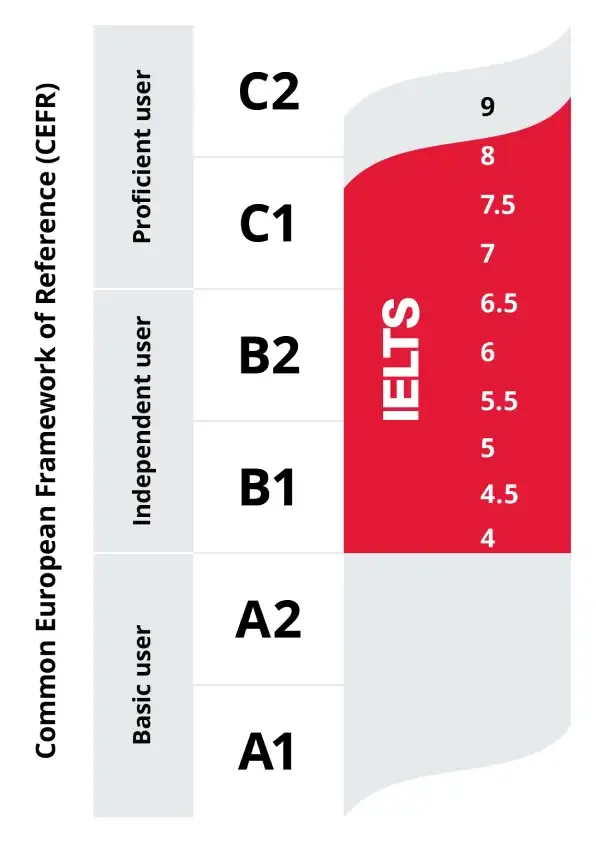
These CEFR levels translate directly into IELTS for UKVI scores:
B1 → minimum 4.0 in each of the four skills (Listening, Reading, Writing, Speaking).
B2 → minimum 5.5 in each of the four skills.
C1 (for some routes) → minimum 7.0 in each skill.
⚠️ Important: These are visa minimums. Most UK universities set higher entry requirements — typically 6.0–6.5 overall for undergraduate and 6.5–7.0 for postgraduate programmes. Always check your specific course page.
2. IELTS for UKVI vs Academic IELTS – What’s the Difference?
This is one of the most common mistakes. IELTS for UKVI (also called IELTS SELT) is the only version accepted for a UK Student visa when you need to prove your English ability via an IELTS test.
✅ IELTS for UKVI (Academic)
Approved by UKVI as a Secure English Language Test (SELT). Taken at an official UKVI‑approved test centre (in person). Can be used for both visa and university admission.
❌ IELTS Academic (standard)
Not a SELT. Cannot be used for a Student visa application — even if your university accepts it for admission.
Figure 2: Official CEFR to IELTS mapping scale. A minimum level of B2 (IELTS 5.5 in all sub-scores) is mandatory for degree-level UK student visas.
3. March 2026 Change: UKVI IELTS Now Fully Computer‑Based
From 22 March 2026, all IELTS for UKVI tests are delivered exclusively on computer. Paper‑based UKVI IELTS is no longer available.
Figure 3: All official UKVI IELTS testing modernised exclusively to the computer-delivered format starting March 2026.
💻 What this means for you:
Same test format, questions, and scoring as paper‑based.
Faster results – typically in 1–2 days.
More test dates and flexible booking.
One Skill Retake available – retake just one section if needed.
Must still be taken in person at an official test centre.
If you're not comfortable with typing, practise the computer‑delivered format well in advance. The Listening, Reading, and Writing sections are all completed on screen; Speaking remains face‑to‑face with an examiner.
🎥 Video: IELTS for UKVI – Computer‑Based Test Walkthrough
4. When You Don’t Need IELTS – Exemptions & Alternatives
You may not need IELTS at all if you fall into one of these categories:
🌍 Nationality exemption
You are a national of a majority English‑speaking country (e.g. USA, Canada, Australia, New Zealand, Ireland).
🎓 Previous degree taught in English
You hold a degree that was taught entirely in English in a majority English‑speaking country (with UK ENIC confirmation).
📜 GCSE / A‑Level / Scottish Highers
You have passed GCSE, A‑Level, or Scottish Highers in English at the required grade.
🏫 University assessment
Your university confirms your English proficiency directly on your CAS (Confirmation of Acceptance for Studies). Many UK universities can assess your English ability through previous study, interviews, or alternative tests.
Even if you qualify for an exemption, your university may still ask for proof. Always check with your admissions office before assuming you don't need a test.
5. Alternatives to IELTS for UKVI
UKVI approves several Secure English Language Tests (SELTs) besides IELTS. These include:
PTE Academic UKVI (Pearson)
LanguageCert International ESOL SELT
Trinity ISE (taken in the UK)
For university admission (not visa), many institutions also accept TOEFL iBT, Duolingo, or Cambridge C1/C2. However, for the visa itself, you must use a UKVI‑approved SELT.
6. University Requirements Are Often Higher Than UKVI Minimums
While UKVI sets the floor, your university sets the ceiling. Typical 2026 entry requirements:
Course Level
Typical IELTS for UKVI Score
Foundation / Pre‑sessional
5.0 – 5.5 overall
Bachelor’s (Undergraduate)
6.0 overall (no band below 5.5)
Master’s (Postgraduate)
6.5 overall (no band below 6.0)
Top‑tier / Russell Group universities
7.0 overall (no band below 6.5)
Always check the specific course page on your chosen university’s website. Some programmes (e.g. Law, Medicine, Journalism) may require 7.5 or higher.
7. Scholarships & Key Resources for 2026–2027
Planning your UK study journey goes beyond English tests. Here are some top scholarships and guides to help you:
🌍 Chevening Scholarships – UK government’s global scholarship programme. Applications for 2027/28 open in August 2026.
🎓 Commonwealth Shared Scholarships – for students from Commonwealth countries.
🏛 University‑specific scholarships – many UK universities offer merit‑based awards for international students.
Q1: What is the minimum IELTS score for a UK student visa in 2026?
For degree‑level courses (B2): 5.5 in each of the four skills. For below degree‑level (B1): 4.0 in each skill.
Q2: Can I use Academic IELTS for a UK student visa?
No. You must take IELTS for UKVI (Academic) at a UKVI‑approved test centre. Standard Academic IELTS is not a SELT and cannot be used for the visa.
Q3: Is IELTS going completely computer‑based in 2026?
Yes. From 22 March 2026, all IELTS for UKVI tests are delivered on computer only.
Q4: Can I get a UK student visa without IELTS?
Yes, in some cases. Exemptions apply if you are a national of a majority English‑speaking country, have a degree taught in English, or if your university confirms your English ability on your CAS.
Q5: What other English tests are accepted for a UK student visa?
UKVI also accepts PTE Academic UKVI, LanguageCert SELT, and Trinity ISE (UK only) as Secure English Language Tests.
Q6: Does the IELTS requirement change if I'm applying for a pre‑sessional course?
For pre‑sessional courses (below degree level), the visa requirement is B1 (4.0 in each skill). However, the university may require a higher score for entry onto the course itself.
Master IELTS Speaking Part 2: The Ultimate PPF (Past, Present, Future) Method Master IELTS Speaking Part 2: The Ultimate PPF (Past, Present, Future) Method Published by the Abreez IELTS Editorial Team | June 22, 2026 The IELTS Speaking Part 2 long turn is notorious for causing anxiety among even highly proficient English speakers. You are given a prompt card (cue card), handed a pencil and paper, and told you have exactly 60 seconds to prepare a monologue that you must sustain for between one and two full minutes. For a vast majority of test-takers, the nightmare isn't a lack of vocabulary—it's running out of things to say at the 75-second mark, leading to long, awkward silences that pull down their Grammatical Range and Fluency scores. Sustaining a conversation naturally for two full minutes requires a structured approach to prevent awk...
Mastering Rapid Skimming Techniques: Read 900 Words in 2 Minutes Mastering Rapid Skimming Techniques: How to Read a 900-Word Text in Under 2 Minutes to Locate Key Ideas Time is your ultimate currency when tackling complex reading exams like the IELTS, academic research papers, or heavy professional briefs. Imagine opening a lengthy document containing exactly 900 words. Under normal circumstances, an average reader takes anywhere between three to four minutes to digest this volume of text. However, when the clock is ticking, you don't have the luxury of traditional reading. You need a strategy that shifts your reading paradigms completely. Welcome to the art of rapid skimming techniques . Skimming is not merely "reading fast" or casually skipping lines; it is a highly structured, deliberate, and cognitive process ...
Vocabulary: 10 Advanced Synonyms for "Important" and "Good" | Elevating Your Lexical Resource Score Beyond the Basics: 10 Advanced Synonyms for "Important" and "Good" to Hit IELTS Band 8+ If you are preparing for the IELTS exam, you probably already know that repetitive language is the ultimate enemy of a high band score. When an examiner reads an essay where everything is "good" and every issue is "important," it signals a limited vocabulary range. To achieve a Band 8 or 9 in the Lexical Resource category—which accounts for 25% of your total score in both the Writing and Speaking modules—you must demonstrate precision, variety, and an ability to use less common, idiomatic words correctly. In this comprehensive guide, we will break down 10 advanced synonyms for "important" and "good." We won’t just give you a list of words; we will look at how to use them contextually with complete s...
IELTS Academic vs General Training: The Ultimate Selection Guide IELTS Academic vs. General Training The Definitive Guide to Choosing the Right Exam for Your Future Home Hub Prep Hub Scoring Guide Study Plans The Ultimate Choice: Academic or General Training?[span_0](start_span) If you are planning to move, study, or work abroad in an English-speaking country, taking the International English Language Testing System (IELTS) is a major milestone[span_0](end_span). However, right at the start of your registration process, you will face an important decision: Should you choose IELTS Academic or IELTS General Training?[span_1](start_span) [span_1](end_span) Selecting the incorrect module can cost you time and registration fees, as institutions rarely accept one in place of the other. [span_2](start_span)While both modules evalua...
Mastering IELTS Academic Writing Task 1: Analyzing Side-by-Side Bar Charts & Grouping Static Data Mastering IELTS Academic Writing Task 1 Analyzing Side-by-Side Bar Charts and Grouping Static Categories Logically Home Hub Expert Strategies Sequencing & Processes Free Mock Tests Introduction to Comparative and Static Bar Charts The IELTS Academic Writing Task 1 can feel incredibly daunting, especially when you are confronted with multiple visual elements presented simultaneously. Among the various chart types you might encounter, side-by-side bar charts displaying static data are notorious for overwhelming candidates. Unlike dynamic charts that trace changes over a clear timeline, static charts capture a single snapshot in time. Your challenge shifts from describing "trends" to making meaningful, organized structural comparisons. When th...
🎯 Strategy & Core Skills How to Calculate Your IELTS Band Score: The Definitive 2026 Strategy Guide An exhaustive breakdown of the mathematical rounding rules, module-specific scoring mechanics, and hidden strategies to push your score to Band 7.0–9.0. Succeeding on the International English Language Testing System (IELTS) requires more than language fluency—it demands tactical mastery over the grading architecture itself. Your final IELTS band score is never a subjective estimation. Instead, it is the product of an exact mathematical formula that processes your performances across four distinct areas: Listening, Reading, Writing, and Speaking. Many candidates spend countless hours reviewing materials without understanding how individual raw marks correlate to their final score report. By peeling back the layers of this system, you can develop a smart study plan. Knowing where you can tolerate...
Grammar Mastery: Subject-Verb Agreement Rules and Fixes Grammar Mastery: Mastering Subject-Verb Agreement Fixing the #1 structural error that drags down academic writing and professional scores. Among the variables evaluated across academic written pieces, one foundational parameter directly controls structural clarity: subject-verb agreement (SVA) . Whether preparing materials through an integrated IELTS Smart Band 9 Preparation Hub track or developing high-level corporate documentation, agreement errors instantly break structural flow. This comprehensive breakdown reviews systematic strategies to clear out syntax issues and ensure consistent mechanical control. Figure 1: Core parameters of subject-verb syntax optimization across formal writing styles. 1. The Fundamental Framework: Structural Numbers The core logic behind structural agreement focuses on matching quantities:...
The Ultimate 4-Paragraph Essay Masterclass | Elite Writing Framework Perfecting the 4-Paragraph Essay Structure: The Exact Structure Needed for Clear Progression Elite Academic Blueprint: Achieve compositional excellence with a high-impact introduction, razor-sharp thematic blocks, and a resonant final resolution engineered for flawless logical progression. Flawless execution: A streamlined structure maximizes analytical clarity and structural authority. The 4-paragraph essay is a masterclass in structural economy. It strips away rhetorical noise to present arguments with exceptional clarity and driving momentum. It is the framework of choice for competitive timed conditions, high-stakes university entry requirements, and focused academic responses. This master guide breaks down the precise structural engineering of the 4-paragraph ...
Rapid Skimming Techniques: How to Read a 900-Word Text in Under 2 Minutes to Locate Key Ideas A data-driven masterclass on cognitive text extraction, mechanical pacing, and breaking the baseline word-by-word barrier under exam conditions. Category: Advanced Academic Reading Strategies | Estimated Reading Time: 12 minutes Time is the ultimate structural gatekeeper in high-stakes professional evaluations, academic certifications, and intensive data environments. When faced with a sprawling, dense, 900-word academic or analytical passage, the deeply ingrained instinct of most readers is to process information linearly—meticulously moving from left to right, word by word, line by line. While this method serves elementary reading development, it introduces a severe structural liability when operating withi...






Comments