Prepare for IELTS with Shahida Noreen. Get Band 7+ Writing, Speaking, Reading and Listening strategies, AI-powered study tools, model answers, and daily practice lessons.
Which One Should You Take? Paper-Based vs. Computer IELTS Which One Should You Take? Paper-Based vs. Computer IELTS The digital edge: Modern computer-delivered testing centers provide private workstations with dedicated noise-canceling headsets. By Shahida Noreen | Founder & Chief Content Strategist at IELTS Smart Published: June 2026 | Reading Time: 11 Minutes [span_0](start_span) When you begin your journey toward achieving target score benchmarks, choosing your test format is one of your most foundational decisions[span_0](end_span). [span_1](start_span)A common question among language learners is: "Should I choose the traditional paper-based test or the computer-delivered format?" [span_1](end_span) The answer isn't as simple as checking a box. [span_2](start_span)Your choice can impact your time management, editing flow, and overall performance on test day[span_2](...
Get link
Facebook
X
Pinterest
Email
Other Apps
IELTS Requirements for US Universities: Ultimate 2026 Guide
Get link
Facebook
X
Pinterest
Email
Other Apps
IELTS Requirements for US Universities: Ultimate 2026 Guide
IELTS Requirements for US Universities: The Ultimate 2026 Strategy Guide
By Shahida Noreen | Senior Academic Instructor & Confidence Coach at IELTS Smart Published: June 2026 | Target Reading Time: 12 Minutes
Packing your bags to study in the United States is one of the most exciting decisions an international student can make. From the innovative tech hubs of Silicon Valley and the finance centers of New York City to historic Ivy League lecture halls, American higher education offers world-class opportunities. However, before you can wander down those campus avenues, you must cross one crucial bridge: proving your English language proficiency.
Historically, international applicants assumed the US accepted only domestic validation tests like the TOEFL. But times have dramatically evolved. In 2026, more than 3,400 higher education institutions across the USA—including almost all top-ranked universities—warmly accept and recognize the International English Language Testing System (IELTS) Academic exam.
Yet, simply knowing the test is accepted isn't enough. American universities operate on an autonomous admission philosophy. This means there is no uniform national cutoff band score. Your target depends entirely on your chosen major, degree level, and institutional tier. In this comprehensive guide from the team at IELTS Smart, we break down the definitive 2026 data points, clear up visa misconceptions, highlight pathway mechanics, and give you an actionable roadmap to hit your target score.
Visualizing your future: Achieving your target IELTS band opens the gates to vibrant campus spaces across the USA.
The F-1 Student Visa vs. University Admission Guidelines
One of the most persistent myths blocking international candidates from making strategic decisions is confusing immigration benchmarks with academic standards. Let’s set the record straight: The US Department of State and local US Consulates do not mandate a universal minimum IELTS score for an F-1 Student Visa.
Instead, the immigration framework depends entirely on documentation issued directly by the school. When an American university formally reviews and approves your academic credentials, they issue a document called the Form I-20 (Certificate of Eligibility for Nonimmigrant Student Status). To secure this form, you must meet the institutional language requirements established by that university's specific academic department.
When you sit across from a visa officer during your mandatory interview, they will not quiz you on individual test parameters. Instead, they cross-examine whether your real-time speaking capacity matches the academic commitment verified on your I-20 documentation. If you want to benchmark how this framework differs across global destinations, read our comprehensive overview analyzing the ultimate system benchmarks for international studies to learn how European and American destinations frame entry criteria.
IELTS Smart Pro Tip: The Sectional Balance Rule
While an overall band score is important, admissions committees evaluate individual sub-scores carefully. Many competitive STEM and business programs will reject an applicant with a stellar 7.5 overall band if their Writing or Speaking subset drops below a 6.0. Balanced preparation is essential.
Definitive 2026 Score Targets by Degree Category
Because there is no centralized authority, analyzing requirements requires sorting options into practical degree tiers. Expectations scale depending on the communication demands of the curriculum. For instance, a student spending hours in a complex laboratory needs solid technical vocabulary, whereas a student drafting legal or business case studies must display fluid mastery over nuanced language patterns.
Below is a centralized matrix illustrating standard entry criteria for mainstream paths in 2026:
Degree Track
Minimum IELTS Band Scope
Highly Competitive Target Score
Critical Section Focus Area
Associate Degrees / Community Colleges
5.5 – 6.0
6.5
Listening comprehension for introductory lectures.
Undergraduate Programs (BA, BS)
6.0 – 6.5
7.0
Reading speeds to manage large-scale weekly assignments.
Postgraduate Tracks (MA, MS, PhD)
6.5 – 7.0
7.5
Writing proficiency for advanced academic research papers.
Elite Professional Degrees (MBA, JD, MD)
7.0 – 7.5
8.0
Dynamic Speaking and nuanced logical argumentation.
Deconstructing University Requirements by Institutional Tiers
To help you formulate an effective school list, let’s audit real-world institutional standards across distinct academic landscape categories for the 2026 admission cycles.
Tier 1: The Ivy League & Highly Selective Global Leaders
Elite private research organizations look for absolute fluency. They expect incoming students to absorb intense, fast-paced lecture environments and drive high-level classroom arguments without language-based friction. Let's look at the benchmarks:
Stanford University: Requires a absolute minimum of 7.0 for graduate admissions. However, standard tracking profiles indicate that securing an 8.0 overall score is highly beneficial to bypass remedial on-campus evaluations.
Harvard University: Requires a 7.0 minimum for undergraduate admissions, but graduate fields like the Harvard Business School or the Graduate School of Education enforce a strict, unyielding 7.5 threshold.
Columbia University: Enforces a comprehensive across-the-board minimum requirement of 7.5 for most advanced humanities and journalistic disciplines.
Tier 2: Premier Public Research Powerhouses
State-funded flagship universities offer top-tier research opportunities and large, diverse campus populations. Their score cutoffs balance accessibility with high academic standards:
University of California, Berkeley (UC Berkeley): Direct undergraduate placement requests a 6.5 band, while competitive master's programs expect a minimum of 7.0.
University of California, Los Angeles (UCLA): Adheres to a strict entry floor of 7.0 across both undergraduate and graduate applicant pools.
Purdue University & UT Austin: Generally require a reliable 6.5 overall band score, provided individual subsections stay above a 6.0.
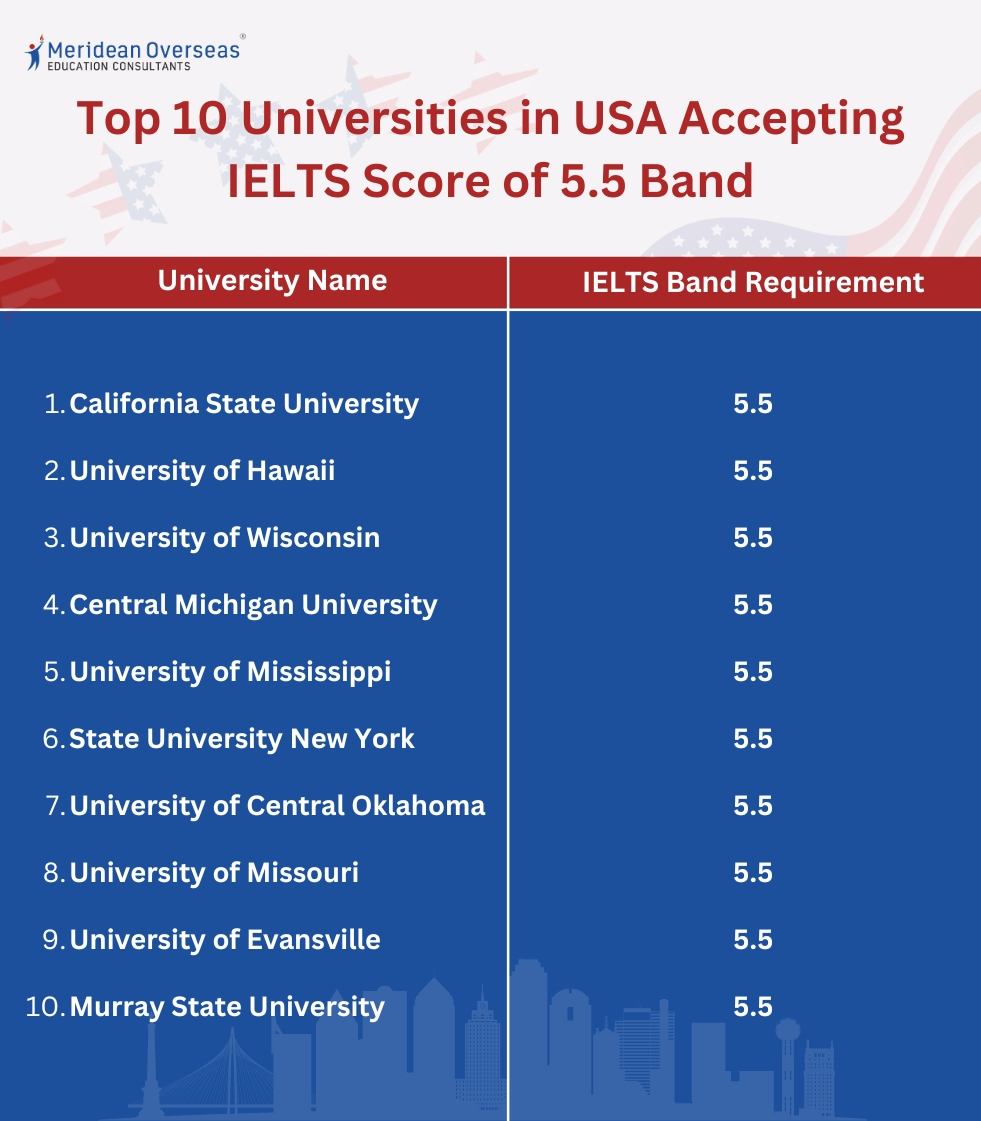
Data Visualization: While elite tracks request a 7.0+, multiple mid-tier and regional options provide secure pathways starting at a 5.5 band score.
Navigating the 5.5 Baseline: Pathway Options Explained
What happens if your latest diagnostic or real-world exam results settle around an overall band score of 5.5? Don't panic or discard your study abroad dreams. While a 5.5 limits your chances for direct admission to top-tier state flagships, it opens up a well-established alternative: Conditional Admission via Pathway Programs.
Many regional public institutions, such as multiple branches of the California State University network, offer these bridges. Under a conditional acceptance structure, the university accepts your academic and GPA history, but adds a strict condition: before you can register for your core undergraduate or graduate classes, you must complete an intensive English language module directly on campus.
While this option extends your degree timeline by a semester or two, it serves as a helpful immersive buffer to ease your transition into American academia. To build a solid foundation before encountering these strict language thresholds, review our masterclass on international application documentation and requirements.
Mastering the Structural Layout: What to Expect on Test Day
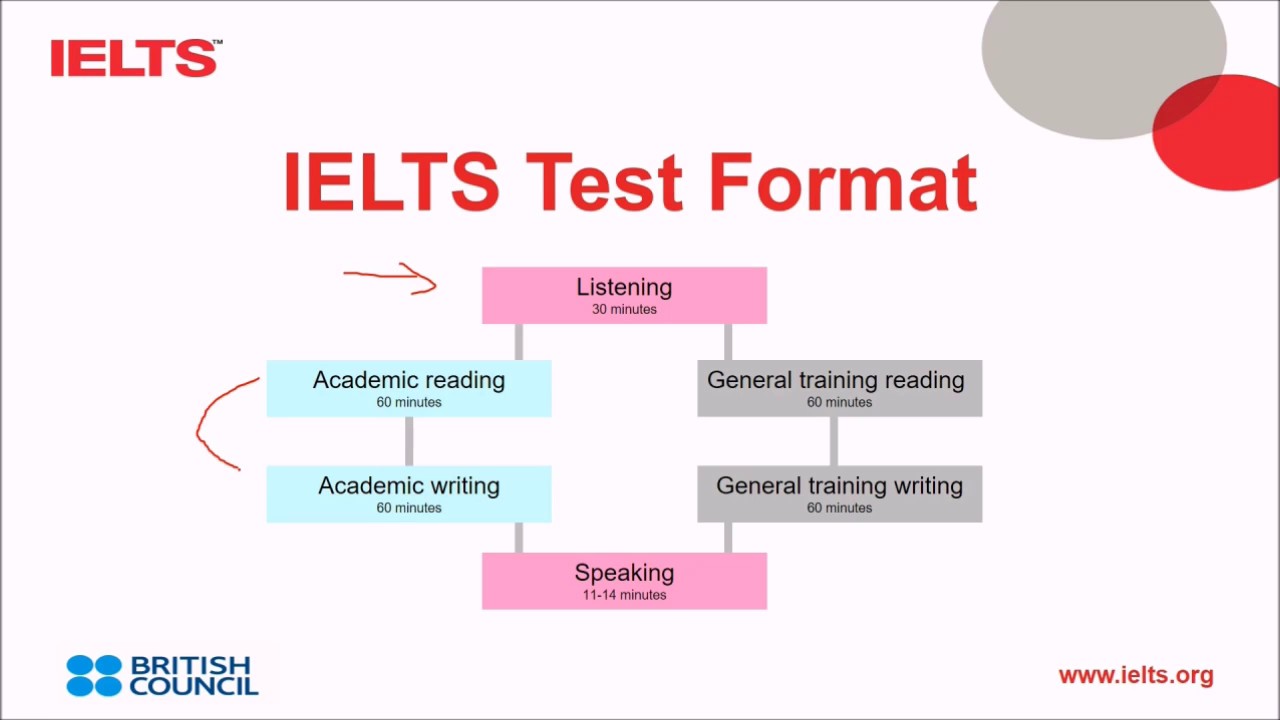
To hit a competitive band score like 7.0 or 7.5, you need to understand the structural blueprint of the exam. The IELTS Academic exam tests your skills across four distinct modules, designed to mirror real-world tasks you will face in American classrooms.
The Academic Blueprint: Balancing your performance across all four functional quadrants is key to securing high-tier institutional approvals.
The "0.5 Band Advantage" for Funding and Financial Aid
Here is an insider secret that general consulting agencies rarely share: **Never train to just hit the minimum required score.** If your target university requires a 6.5, you should structure your target goal to secure a 7.0. At IELTS Smart, we call this strategy the 0.5 Band Advantage.
American graduate programs fund their departments largely through roles like Graduate Teaching Assistantships (TA) or Graduate Research Assistantships (RA). A teaching assistant is responsible for leading discussion groups, grading undergraduate papers, and holding office hours. Because these roles require clear, effective public speaking, departments look closely at your language proficiency scores.
An applicant with a 7.5 or 8.0 overall score—and an exceptional Speaking subsection—will consistently beat out candidates who scraped by with the minimum requirement. That extra 0.5 band could save you thousands of dollars in tuition fees.
Pre-Application Checklist for US Universities
Confirm if your targeted major requires a specialized departmental IELTS score rather than the general university minimum.
Double-check whether your target school requires physical paper Test Report Forms (TRF) or accepts safe electronic delivery.
Verify if the institution provides complete IELTS waivers for applicants who completed their secondary education at English-medium institutions.
Align your exam schedule to receive your official scores at least 6 weeks before the university's early application deadline.
Expert Preparation Resources & Walkthrough Video
Achieving your dream score requires consistent practice and expert strategies. Watch our step-by-step video breakdown below, covering high-scoring structures for the Academic Writing task and tips to improve your delivery for the Speaking module:
For more detailed updates, official regulations, and test venue changes across the United States, look at the authorized registration body on The Official IELTS International Testing Portal to review immediate test center availability near your location.
Frequently Asked Questions (FAQ)
Is IELTS accepted in all US universities?
Yes, over 3,400 higher education institutions across the United States accept the IELTS Academic test as proof of English language proficiency. This includes almost all major public universities, private colleges, and elite Ivy League institutions.
Can I get a US student visa with a 5.5 IELTS band?
The US Embassy does not set a hard minimum score requirement for an F-1 student visa. However, you must first secure a Form I-20 from a certified school. While direct entry with a 5.5 is difficult, you can qualify via Conditional Admission or pathway options by completing an Intensive English Program (IEP).
Does a higher IELTS score increase my scholarship chances in the USA?
Absolutely. High-performing students who clear a band score of 7.5 or 8.0 stand out to admissions panels. This premium score heavily enhances your eligibility for merit-based academic scholarships and competitive teaching or graduate research assistantships.
Do US universities require institutional code for IELTS?
Unlike the TOEFL, most American universities do not require a specific numerical code for IELTS reporting. Instead, you select the university name, department, and specific campus address directly via your official test center portal to securely transmit your digital Test Report Form (TRF).


Comments