Prepare for IELTS with Shahida Noreen. Get Band 7+ Writing, Speaking, Reading and Listening strategies, AI-powered study tools, model answers, and daily practice lessons.
How IELTS Band is Calculated: The Ultimate Guide and Score Calculator How IELTS Band is Calculated: The Ultimate Guide and Score Calculator Updated for Peak Performance | Expert Analysis If you are planning to immigrate, study overseas, or gain professional licensure abroad, you already know that the International English Language Testing System (IELTS) is your primary gateway. To unlock competitive universities or preferred visa streams, a Band 7 or higher is almost universally required. However, when candidates sit down to take their diagnostic practice exams, they almost always fall victim to a classic, dangerous misconception: "If I get 70% of the questions correct, I will secure a Band 7." Shock Fact Band 7 is NOT 70%. The IELTS grading mechanism does not look at simple percentages. It operates on a precise mathematical framework that converts lo...
Get link
Facebook
X
Pinterest
Email
Other Apps
Mastering IELTS Reading Comprehension: The Ultimate Band 8+ Guide
Get link
Facebook
X
Pinterest
Email
Other Apps
Mastering IELTS Reading Comprehension: The Ultimate Band 8+ Guide
Welcome to the definitive training hub. If you are starting your journey, make sure to visit our Home Resource Center to map out your overall prep tracker.
How to Improve Reading Comprehension for the IELTS: The Band 8+ Blueprint
Let's be completely honest: the IELTS Reading sub-test is not actually a reading test. If you sit down in the exam room intending to read all three long academic texts word-for-word, contemplate their meaning, and then answer the questions, you are virtually guaranteed to run out of time. The clock is your primary adversary.
Instead, the IELTS Reading component is a highly sophisticated, high-speed search-and-match puzzle. It evaluates your ability to rapidly process massive amounts of complex information, filter out background noise, and pinpoint explicit data points and underlying arguments using an intimate understanding of synonyms and parallel expressions.
"Comprehension in the context of IELTS does not mean deep literary analysis—it means high-precision tracking of mapped information under severe time constraints."
The Core Pillars of IELTS Reading Competency
To scale your score from a baseline Band 6 to a secure Band 8 or 9, you must actively train three core operational pillars: structural navigation, targeted scanning metrics, and micro-level contextual synthesis.
1. Structural Navigation (Skimming for the Architecture)
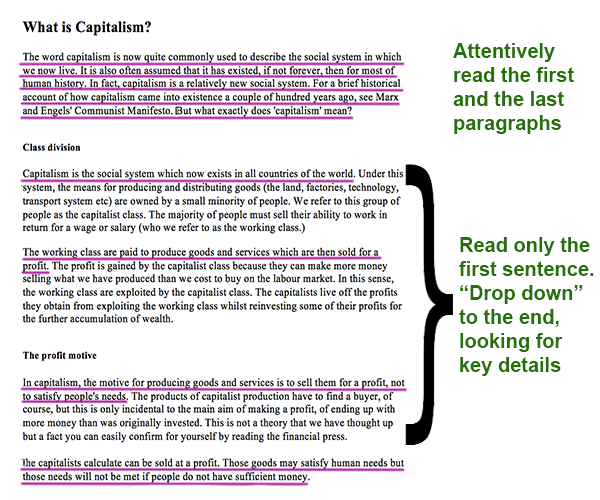
Before you ever look at a question, you need to understand the macro-layout of the text. Skimming means sweeping your eyes across the text over the span of 60 to 90 seconds to build a conceptual map. You are looking for the topic sentence of each paragraph (typically the first or second sentence) and the concluding transition sentence.
Visualizing the structural focus: Target the header, introduction, and paragraph boundaries to unlock the passage's blueprint quickly.
2. Targeted Scanning Metrics (Locating Data Anchors)
Scanning is the physical act of searching for raw data anchors without processing the surrounding grammar. Your eyes should jump across the page looking exclusively for capitalization (Proper nouns, geographic locations), numerical figures (dates, percentages, statistics), and highly specific technical jargon that cannot be easily paraphrased in the questions.
3. Micro-Level Contextual Synthesis
Once your scanning leads you to the correct paragraph location, you must switch gears instantly. This is where you slow down to a crawl and execute deep comprehension, paying meticulous attention to qualifiers like most, some, all, rarely, traditionally, and unprecedented. A single word can flip the logical valence of an entire paragraph.
Step-by-Step Execution Guide for High-Difficulty Questions
Different questions require vastly different analytical frameworks. Let's break down the execution strategies for two of the most notoriously difficult question paradigms on the test.
Mastering Sentence Completion
Sentence completion tasks are highly predictable because they almost always follow the sequential narrative order of the text. However, they easily catch students off guard with complex structural grammar shifts between the text and the question prompt.
When you approach these, you must proactively determine the exact grammatical class (noun, verb, adjective, or adverb) required to fill the blank space smoothly. If you need advanced training drills on breaking down these structural traps, consult our granular deep-dive on Mastering IELTS Reading Sentence Completion.
Deconstructing True, False, Not Given (TFNG)
TFNG is arguably the single largest point-drainer for high-achieving candidates. The confusion almost always stems from a fundamental misunderstanding of what "Not Given" actually means.
TRUE: The text directly confirms the statement, using clean synonymous matches.
FALSE: The text explicitly states the opposite or contradicts the assertion directly.
NOT GIVEN: The text mentions the general subject matter, but it is impossible to confirm or deny the precise assertion because the vital link of information is missing.
For a comprehensive, question-by-question breakdown of real test scenarios involving these traps, study our detailed guide on how to Master True, False, Not Given Questions.
The Vocabulary Paradigm Shift
You cannot read your way past a severe vocabulary deficit. The IELTS Reading test relies heavily on keyword transformation matrices. The word used in the question will rarely be the word used in the text.
Consider the following dynamic transformation example:
Question Text Phrasing
Passage Synonymous Match
Core Transformation Focus
"Detrimental impacts on the native ecosystem"
"Devastating consequences for local flora and fauna"
Latinate abstract vocabulary shifted to concrete biological synonyms.
"Accelerated urban development over a decade"
"Rapid proliferation of built environments across ten years"
Time span conversion and noun-to-adjective restructuring.
To study official technical guidelines on how these matrices are compiled, benchmark your practice routines against the authoritative assessment structures detailed on the Official IELTS International Website.
Interactive Video Workshop: Critical Reading Drills
To help you visualize these scanning and skimming techniques working in real-time on actual exam papers, watch this guided breakdown video:
A Data-Driven Practice Regiment
Do not just blindly print out past papers and take them back-to-back without an analytical review process. True comprehension growth happens during post-test correction analysis. Every time you miss an answer, you must document exactly *why* you missed it in an error log:
Did I look at the wrong part of the text entirely? (Scanning error)
Did I locate the right text, but misinterpret a key synonym? (Vocabulary error)
Did I run out of time and guess randomly? (Pacing error)
To begin executing this structured practice layout immediately, download our full analytical diagnostic matrix inside the comprehensive repository at our IELTS Reading Practice Tests & Score Trackers.
Frequently Asked Questions (FAQ)
How can I improve my reading speed for IELTS without losing comprehension?
Focus heavily on skimming for the macro architecture of a paragraph (reading the first and last sentences) and scanning for specific, unalterable keywords like names, numbers, and dates rather than reading every single word linearly.
Why do I always run out of time in the IELTS Reading test?
Most students run out of time because they treat the IELTS test like an interesting textbook or novel and try to read every sentence deeply. The test evaluates your ability to locate information quickly using synonyms and keyword matching. Keep moving; never spend more than 90 seconds on a single question.
What is the best way to handle 'True, False, Not Given' questions?
Understand the difference between False (the text says the exact opposite) and Not Given (the text mentions the general topic but doesn't confirm or deny the specific claim). Never assume, deduce, or use outside knowledge. If the exact fact is missing, it is unconditionally Not Given.
Mastering Formal Letter Writing: The Ultimate Premium Guide for IELTS, Business, and Career Success Mastering Formal Letter Writing: The Ultimate Premium Guide for IELTS, Business, and Career Success An exhaustive blueprint on structural anatomy, advanced linguistics, tone cultivation, and high-scoring templates. In our increasingly digital world, the written word remains the ultimate standard of professionalism. Whether you are navigating the high stakes of the IELTS General Training examination, drafting an official corporate grievance, communicating with public administrators, or presenting a high-level academic request, your command over formal letter writing stands as a critical indicator of your communicative competence. Writing an exceptional formal letter demands far more than merely organizing your thoughts li...
Mastering IELTS Writing Task 2 Double Question Essays: A Complete Band 9 Guide Mastering IELTS Writing Task 2 Double Question Essays: The Ultimate Band 9 Strategy Guide Among all the essay types encountered in the IELTS Academic and General Training Writing modules, the Double Question Essay (often referred to as the Direct Question Essay or Two-Part Question Essay ) stands out as unique. While opinion essays or discussion essays require you to balance opposing viewpoints, the double question prompt asks you to play detective and answer two entirely distinct queries based on a single background statement. Many candidates find themselves overwhelmed by this format because they fail to properly allocate space or structure their ideas cleanly. If you fall into this trap, your score for Task Achievement and Coherence can plummet rapidly. In this premium guide, we will unpack the exact blueprint ...
IELTS vs TOEFL: Full Comparison 2026 – Which English Test Is Easier? IELTS vs TOEFL: Full Comparison – Which English Test Is Easier in 2026? Choosing between IELTS and TOEFL is one of the biggest decisions for students planning to study, work, or immigrate abroad. Both exams measure English language proficiency, but they differ significantly in format, scoring, speaking style, and overall test experience. This comprehensive guide compares every important aspect of IELTS and TOEFL so you can confidently choose the exam that best matches your goals. Table of Contents What is IELTS? What is TOEFL? Main Differences Which Test is Easier? Reading Comparison Listening Comparison Speaking Comparison Writing Comparison Scoring System Acceptance Worldwide Fees Comparison FAQ Featured Image Suggested Alt Text: IELTS vs TOEFL comparison for study abroad students. Watch Before Reading What is IELTS? The Internati...
How to Beat IELTS Test Anxiety and Boost Your Score: Top 10 Psychological Strategies ANXIETY SHIELD BAND 9 MAXIMUM SCORE PSYCHOLOGICAL TIMING IELTS BEHAVIORAL MASTERCLASS 10 Ways to Neurologically Disarm Test Panic & Secure Your Band Targets How to Beat IELTS Test Anxiety and Boost Your Score: Top 10 Psychological Strategies Premium Psychological Inoculation Guide • Band 7+ Mindset Walking into an IELTS...
Minimum IELTS Score for Canada PR & Australia Immigration: The Ultimate Permanent Residency Guide CANADA PR Min Baseline: CLB 7 AUSTRALIA GSM Min Baseline: Competent 8777 GOLD STANDARD The Permanent Residency Language Blueprint Comprehensive Analysis of IELTS Thresholds for Immigration pathways Minimum IELTS Score for Canada PR & Australia Immigration Compreh...
Mastering IELTS Reading Sentence Completion: The Ultimate Band 9 Strategy Guide Mastering IELTS Reading Sentence Completion: The Ultimate Band 9 Strategy Guide Premium Instructional Resource • Advanced Level Sentence completion questions appear frequently across both Academic and General Training modules of the IELTS Reading test. While they look straightforward—just fill in the blank with words directly extracted from the text—they frequently trip students up. Misreading word counts, falling for clever paraphrasing trap doors, or choosing the wrong grammatical word form can rapidly drop your band score. If you are looking to master the entire reading module, make sure to visit our comprehensive IELTS Reading Hub to build a solid foundational strategy. In this guide, we will break down exactly how to conquer sentence completion questions step-by-step with zero margin for error. 1. What is Reading Sentence Compl...
The Ultimate Masterclass to IELTS Speaking Part 1 (Hobbies & Routines) and High-Scoring General Writing Tasks Published by Abreez Academic Team • Last Updated: June 30, 2026 Figure 1: Strategic synthesis of complex syntax and dynamic lexical fields forms the bedrock of a Band 8+ IELTS output. Introduction: Deconstructing the Myth of "Simplicity" in IELTS Base Modules Many candidates approach the IELTS exam with a fragmented mentality, treating the Speaking module as an isolated conversational exercise and the General Writing Task as a distinct linguistic hurdle. This strategic disconnect is most apparent in how test-takers handle elementary prompts like Hobbies & Routines in Speaking Part 1, or how they draft contextual correspondence in General Writing Task 1. They falsely assume that simple topic...
The Ultimate 4-Paragraph Essay Masterclass | Elite Writing Framework Perfecting the 4-Paragraph Essay Structure: The Exact Structure Needed for Clear Progression Elite Academic Blueprint: Achieve compositional excellence with a high-impact introduction, razor-sharp thematic blocks, and a resonant final resolution engineered for flawless logical progression. Flawless execution: A streamlined structure maximizes analytical clarity and structural authority. The 4-paragraph essay is a masterclass in structural economy. It strips away rhetorical noise to present arguments with exceptional clarity and driving momentum. It is the framework of choice for competitive timed conditions, high-stakes university entry requirements, and focused academic responses. This master guide breaks down the precise structural engineering of the 4-paragraph ...
✦ WRITING TASK 2 ✦ BAND 9 DAY 66 IELTS WRITING TASK 2 TECHNOLOGY & AI Full Band 9 Model Essay · Advanced Collocations · 2025 Band 9 Target Score Model Answer 300 words Essay Length Optimal Range 4 Criteria All Covered TA·CC·LR·GRA AI 🤖 💼 🌐 📊 ✍️ 🎓 ...




Comments