Prepare for IELTS with Shahida Noreen. Get Band 7+ Writing, Speaking, Reading and Listening strategies, AI-powered study tools, model answers, and daily practice lessons.
Tackling dense academic paragraphs can feel overwhelming, especially when preparing for high-stakes exams like the IELTS. However, unlocking complex text is not about reading faster—it is about reading smarter by understanding paragraph mechanics, tracking key transition indicators, and recognizing structural flow. "The secret to unpacking dense text is tracking structural shifts. Treat transitions like road signs telling your brain exactly where the author's argument is moving next." The 4-Step Strategic Breakdown To systematically digest challenging English paragraphs without losing speed or accuracy, apply this operational sequence: Step 1 Isolate the Core Anchor Identify the main focus or topic sentence of the passage. Academic writers typically place their core claim right at the beginning or wrap it up neatly at the conclusion of the paragraph. Step 2 Trace Transition Indicators Keep...
Get link
Facebook
X
Pinterest
Email
Other Apps
IELTS Reading: Master True, False, Not Given Questions (Eliminate Assumptions)
Get link
Facebook
X
Pinterest
Email
Other Apps
IELTS Reading: Master True, False, Not Given Questions (Eliminate Assumptions)
IELTS Reading: Master True / False / Not Given Questions | The Absolute Rules for Identifying Hidden Assumptions
By Shahida Noreen | Core Reading Strategy Module
The **True / False / Not Given (TFNG)** question type remains one of the most significant hurdles for students aiming for a Band 8 or higher on the IELTS Academic or General Reading test. Why? Because these questions do not just test your vocabulary—they actively exploit your brain's natural tendency to form hidden assumptions.
In everyday communication, our brains naturally bridge logical gaps to save processing energy. On the IELTS exam, however, filling in those blanks is a structural trap. To score consistently well, you must think like a computer interpreter: either a fact is entirely supported, explicitly contradicted, or completely absent.
The Golden Rule: Never use outside general knowledge or logical inference to deduce an answer. If the passage does not explicitly confirm a relationship, it does not exist for the sake of the test.
The Core Logic Architecture
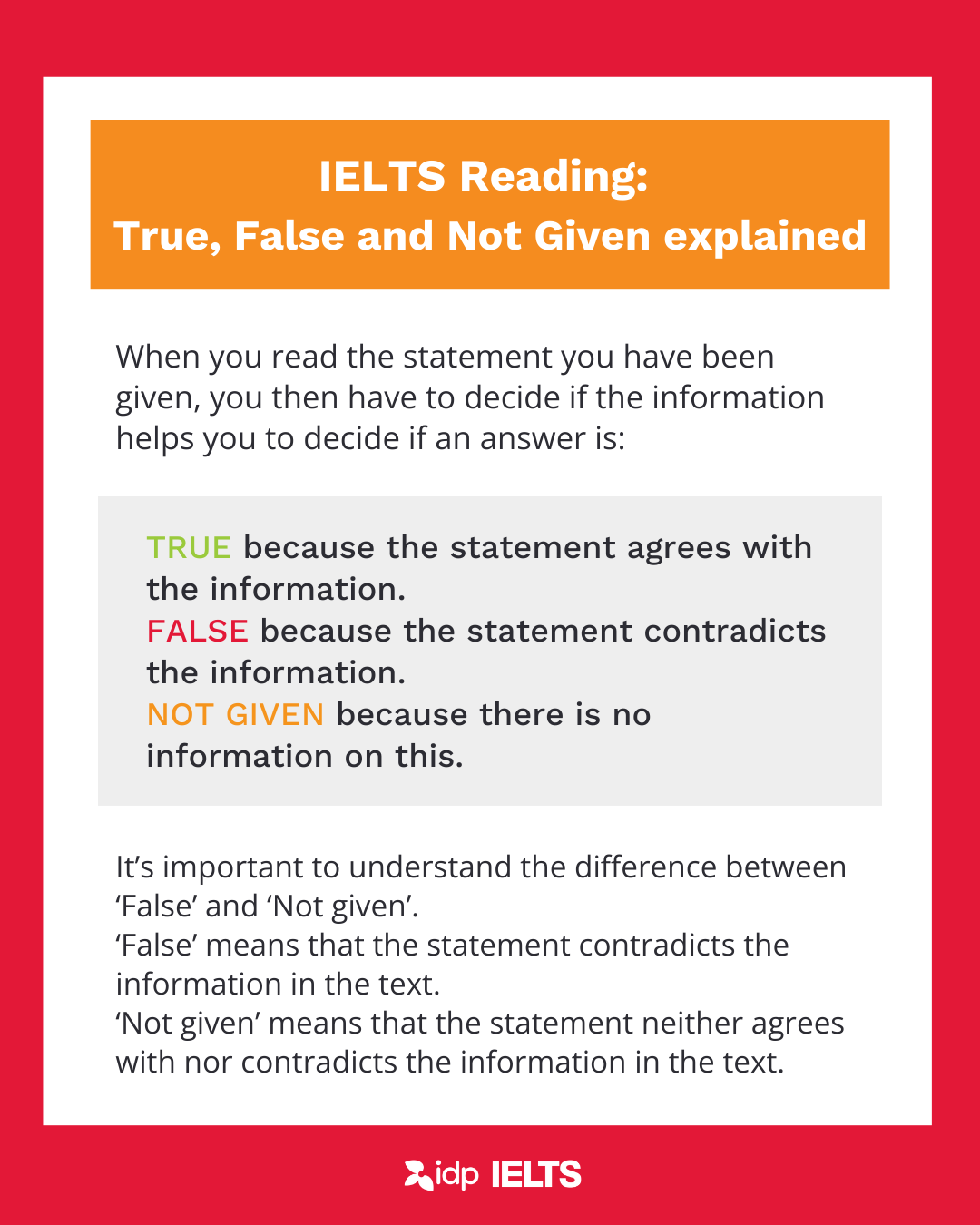
To help visualize exactly how the test developers structure these options, consider the official breakdown of text alignment rules below:
Figure 1: Official structural alignment required to verify factual consistency on the reading paper.
The exam items trick you by modifying structural components within a sentence. Look out for these three specific language features:
The Trap Component
How the Distractor Works
Contextual Example Breakdown
Quantifiers
Altering words like all, most, many, some, few, or none completely changes the truth value.
Text:Most local developers prefer using clean frameworks. Statement:All software developers prefer frameworks. Answer: FALSE
Qualifiers & Modifiers
Limiting conditions with words like predominantly, successfully, allegedly, or solely.
Text: The engineering team designed an innovative processing chip. Statement: The team successfully deployed a faster processing unit. Answer: NOT GIVEN (Design does not guarantee deployment)
Invented Causation
The passage notes two distinct facts running parallel, but the statement artificially builds a cause-and-effect link.
Text: Student enrollment dropped. Laptop pricing structures changed. Statement: Shifting laptop prices led to falling enrollments. Answer: NOT GIVEN (Coexistence is not causation)
Watch this video guide to watch an instructor isolate qualifiers and map explicit sentence structures directly from a sample paragraph:
The Step-by-Step Strategic Filter
Apply this process methodically on every question to keep hidden assumptions from lowering your band score:
1. Deconstruct the Target Statement
Timing: 30 Seconds
Isolate your target phrase's core components. Circle qualifiers like only or first. Identify the precise relationship claimed between the subject and object.
2. Establish Your Scan Coordinates
Timing: 45 Seconds
Search for stable anchor keywords (proper nouns, years, or specialized terms) to locate the target paragraph. Remember, TFNG questions progress chronologically through the text.
3. Test for FALSE First via Direct Contradiction
The Contradiction Test
Ask yourself: "Does this paragraph contain a specific statement that makes this question mathematically or logically impossible?" If yes, mark it FALSE.
4. Differentiate TRUE from NOT GIVEN via Absolute Certainty
The Certainty Check
Ask yourself: "Does the author completely guarantee this fact, or am I filling in parts of the story?" If synonyms back it up completely, mark it TRUE. If any link is missing, mark it NOT GIVEN.
If you need to strengthen your core grammar skills before practicing advanced reading passages, check out our newly launched Grammar Mastery Online Series.
Frequently Asked Questions (FAQ)
Q: What is the fastest way to separate FALSE from NOT GIVEN?
A: To mark an answer as FALSE, you must point to a specific sentence in the text that directly contradicts the question. If the text mentions the overall topic but lacks enough specific details to confidently prove the statement wrong, the answer must be NOT GIVEN.
Q: Do True, False, Not Given answers appear in chronological order?
A: Yes. True, False, Not Given questions follow the order of information in the passage. If you locate the answer to question 1 and question 3, the answer to question 2 will physically reside between those two sections of the text.
Q: Can I write T, F, or NG instead of the full words on my answer sheet?
A: Yes, writing T, F, or NG is fully acceptable on the official IELTS Reading answer sheet. However, make sure your handwriting is perfectly clear to avoid losing marks due to illegible letters.
Music Festival English — Speak Like a Local at Coachella | Smart English 🎶 Music Festival English: Speak Like a Local at Coachella Practical phrases, dialogues, quizzes and tips — ready to paste into your blog or use in videos. Why festivals are great for English practice Music festivals like Coachella , Lollapalooza and Glastonbury are more than concerts — they are immersive language classrooms. You get informal conversations, slang, emotional language and lots of chances to speak with strangers in low-pressure moments. Use this guide to learn festival phrases, practice with dialogues, and boost your listening and speaking skills. ✅ The ultimate guide to festival phrases 1. Getting around & finding your crew Where's the main stage? — Ask for the biggest stage. I'm lost, can you help me find the main stag...
Top 15 American Slang Words & Phrases You Must Know in 2025 Top 15 American Slang Words & Phrases You Must Know in 2025 Understand real American conversations, impress US friends, and boost your English with the most popular slang of 2025. American slang changes quickly, and if you want to sound natural when speaking to US natives, you need to stay updated. In 2025, slang is influenced by pop culture, TikTok trends, sports, and daily conversations . In this post, we’ll explore the top 15 American slang words and phrases you should know, their meanings, examples, and how to use them like a native speaker. 1. “Lit” 🔥 Meaning: Something amazing, fun, or exciting. Example: “That party last night was lit!” 2. “Flex” 💪 Meaning: To show off, usually money, style, or skills. Example: “He’s always flexing his new sneakers on Instag...
At the Grocery Store — Words You Really Need | Smart English At the Grocery Store — Words You Really Need Practical English for real shopping — with story, dialogues, and video practice. Shopping is a daily task — but for English learners it’s also a powerful chance to practise real language in real moments. This lesson gives you a short story to connect emotionally, clear vocabulary, natural dialogues, and three working videos to shadow and repeat. Story: One Small Victory Raza moved to a new city and his first solo supermarket trip felt like an exam. He held a short list — milk, eggs, bread, tomatoes — and pushed a cart through the bright aisles. At the cereal aisle, he hesitated. Then he asked a staff member, “ Excuse me, could you tell me where the rice is? ” The staff pointed and said, “ Aisle four, next to pasta. ” At checkout, the c...
IELTS Smart Premium: Writing Task 2 2026 – Technology & AI Topics (Band 7–9) PREMIUM FREE RESOURCE IELTS Writing Task 2 2026 Technology & Artificial Intelligence Topics Band 7–9 Templates, Vocabulary & Model Essays By Shahida Noreen • CELTA-certified IELTS Coach • IELTS Smart In 2026, AI and Technology topics are extremely common in IELTS Writing Task 2. This guide provides everything you need for Band 7–9 success: ready-to-adapt templates, high-scoring vocabulary, and a full Band 8 model essay. Most Expected Questions (2026) Some people believe that artificial intelligence will eventually replace human teachers... To what extent do you agree or disagree? AI will replace many human jobs... Discuss both views and give your opinion. Artificial intelligence for automated grading and personalized learning... Do the advantag...
IELTS Listening Test 3 with Answers (Intermediate) - Day 21 📅 DAY 21 IELTS Listening Test 3 with Answers (Intermediate) Challenge Yourself with Advanced Comprehension Take Test 3 to improve comprehension and speed. Download the PDF and check your answers. This test features more complex conversations and academic lectures designed to push your listening skills to the next level. Ready to tackle intermediate-level challenges? This comprehensive practice test mirrors the actual IELTS exam format with four distinct sections, each increasing in difficulty. Practice makes perfect - simulate real exam conditions 40 Questions ...
Past Tense Sentences with Examples | Beginner English Grammar Past Tense Sentences with Examples Simple Past Tense is perfect for beginners! It describes actions or events that happened and finished in the past (yesterday, last week, ago, etc.). Learn confidently with rules, examples, and visuals! Quick Overview of Tenses Timeline Focus on the Simple Past section: completed actions in the past → X on the timeline. Rules for Simple Past Tense (Beginner Level) Regular verbs : Add -ed or -d (walk → walked, play → played, like → liked) Irregular verbs : Memorize common ones (go → went, eat → ate, see → saw, buy → bought) Time words: yesterday, last night/week/year, ago, in 2020, when I was a child Positive Sentences (Affirmative) I watched a movie yesterday. She played football after school. We went to the park last weeke...
IELTS Speaking Part 2: Advanced Phrases & Strategies for Band 7+ (2026 Premium Guide) 🗣️ IELTS Speaking Part 2: Advanced Phrases for Band 7+ (2026 Guide) Part 2 (Long Turn / Cue Card) is your chance to shine with fluency, lexical resource & coherence. Use these advanced phrases, idioms & discourse markers to structure vivid, natural 2-minute responses and impress the examiner! Why Advanced Phrases Matter in Part 2 Part 2 requires 1–2 minutes of continuous speech on a cue card topic (e.g., describe a person, place, object, experience, event). Examiners reward: Wide lexical range (beyond basic words) Natural collocations & idioms Discourse markers for logical flow Vivid descriptions & personal reflection Minimal hesitation + confident delivery Tip: Prepare 1–2 phrases per function, not memorize full answers. Practice timing yourself! ...
IELTS Writing Task 2: Band 7+ Essay Template | Complete Guide with Examples Skip to main content 🏆 DAY 27 · HIGH-IMPACT FORMULA IELTS Writing Task 2 Band 7+ Essay Template A flexible 4-paragraph framework for opinion, discussion, advantages/disadvantages, and problem-solution essays. Master structure, PEEL paragraphs, and cohesive devices to boost Coherence, Task Response, and overall score. Structured writing builds confidence — start with the right framework. 🎯 Why this template delivers Band 7+: IELTS examiners reward clear logical progression , well-developed ideas, and appropriate cohesive devices. This repeatable 4-paragraph blueprint helps you stay on task, develop arguments effectively, and finish within 40 minutes. ...
How IELTS Band is Calculated: The Ultimate Guide and Score Calculator How IELTS Band is Calculated: The Ultimate Guide and Score Calculator Updated for Peak Performance | Expert Analysis If you are planning to immigrate, study overseas, or gain professional licensure abroad, you already know that the International English Language Testing System (IELTS) is your primary gateway. To unlock competitive universities or preferred visa streams, a Band 7 or higher is almost universally required. However, when candidates sit down to take their diagnostic practice exams, they almost always fall victim to a classic, dangerous misconception: "If I get 70% of the questions correct, I will secure a Band 7." Shock Fact Band 7 is NOT 70%. The IELTS grading mechanism does not look at simple percentages. It operates on a precise mathematical framework that converts lo...
Ultimate AI Vocabulary for IELTS Speaking Part 3: 200+ Advanced Words, Phrases & Idioms with Real Examples (2026 Updated) Ultimate AI Vocabulary for IELTS Speaking Part 3: 200+ Advanced Words, Phrases & Idioms with Real Examples (2026 Updated) Premium Guide | Band 8.0–9.0 Level Content Introduction Imagine walking into your IELTS Speaking test. The examiner smiles and asks: “To what extent do you think artificial intelligence will replace human jobs in the next decade?” You have plenty of ideas, but can you express them using sophisticated, topic-specific language? This single factor often determines whether you score Band 6.5 or Band 8.5+ in IELTS Speaking Part 3 . In 2025 and 2026, AI vocabulary for IELTS has become more important than ever. Examiners are increasingly asking questions about automation, ethical dilemmas, personalised edu...




Comments