Prepare for IELTS with Shahida Noreen. Get Band 7+ Writing, Speaking, Reading and Listening strategies, AI-powered study tools, model answers, and daily practice lessons.
Tackling dense academic paragraphs can feel overwhelming, especially when preparing for high-stakes exams like the IELTS. However, unlocking complex text is not about reading faster—it is about reading smarter by understanding paragraph mechanics, tracking key transition indicators, and recognizing structural flow. "The secret to unpacking dense text is tracking structural shifts. Treat transitions like road signs telling your brain exactly where the author's argument is moving next." The 4-Step Strategic Breakdown To systematically digest challenging English paragraphs without losing speed or accuracy, apply this operational sequence: Step 1 Isolate the Core Anchor Identify the main focus or topic sentence of the passage. Academic writers typically place their core claim right at the beginning or wrap it up neatly at the conclusion of the paragraph. Step 2 Trace Transition Indicators Keep...
Get link
Facebook
X
Pinterest
Email
Other Apps
Day 2: IELTS Writing Task 2 – The Ultimate Band 7+ Structure Blueprint
Get link
Facebook
X
Pinterest
Email
Other Apps
15-Day Masterclass: Day 2
IELTS Writing Task 2: The Definitive Band 7+ Structural Framework
Master the paragraph-by-paragraph architectural blueprint that examiners use to award high scores in Coherence and Cohesion.
Welcome back to Day 2 of your intensive IELTS journey. Yesterday, we cracked the code on what it takes psychologically and strategically to hit that elusive Band 7 mark. Today, we are shifting from theory to concrete engineering. We are going to analyze the absolute backbone of a high-scoring academic essay: The 4-Paragraph Structural Framework.
Many test-takers approach IELTS Writing Task 2 like a creative writing contest. They start typing with no clear roadmap, hoping that sophisticated vocabulary will mask a chaotic train of thought. This approach is a fast track to a Band 6.0 or 6.5. Examiners do not scan your essay looking for poetic flair; they evaluate it against a strict, standardized set of criteria. Your layout directly determines 50% of your total score via Task Achievement (TA) and Coherence and Cohesion (CC).
Crucial Reminder: In the real test, you have exactly 40 minutes to plan, write, and proofread an essay of at least 250 words. Without an automated, second-nature layout ingrained in your muscle memory, you will waste valuable minutes simply figuring out what to write next.
The Anatomy of a Band 7+ Essay
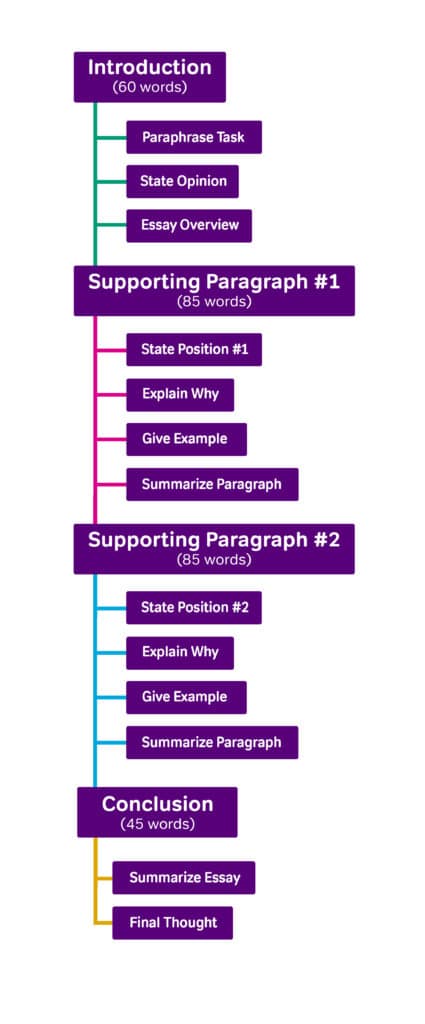
Before we unpack the granular details, let’s look at the spatial distribution of a model response. Notice how balanced the body paragraphs are, and how tightly the introduction and conclusion frame the central thesis:
Figure 1: Standard layout for high-scoring essays highlighting sentence-level objectives. Source: Magoosh IELTS.
Why Structure Dictates Your Score Matrix
To understand why this specific framework works, we must look directly at the official public band descriptors published by the British Council and IDP. Your examiner grades you on four equally weighted categories:
Official Criteria Visual Matrix:
Figure 2: Official public band descriptors matrix highlighting grading boundaries for assessment metrics.
Criteria
What Examiners Look For at Band 7+
Structural Impact
Task Achievement (TA)
Addresses all parts of the task; presents a clear position throughout; presents, extends, and supports main ideas.
Ensures you don't forget to answer a sub-question and forces you to extend your arguments with real-world evidence.
Coherence & Cohesion (CC)
Logically organizes information; clear progression throughout; uses a variety of cohesive devices appropriately; presents a clear central topic within each paragraph.
Enforces the "one idea per paragraph" rule, ensuring transition markers that read naturally rather than mechanically.
Lexical Resource (LR)
Uses a sufficient range of vocabulary flexibility; uses less common lexical items with some awareness of style and collocation.
A clean layout frees up mental processing power so you can focus on selecting precise collocations and topic-specific vocabulary.
Grammatical Range & Accuracy (GRA)
Uses a mix of simple and complex sentence forms; writes frequent error-free sentences; maintains good control of grammar.
By standardizing your sentence functions (e.g., concession sentences, conditional results), you naturally insert complex grammatical structures.
If you want to view a breakdown of prepared structures for different essay types, explore our curated list on the dedicated IELTS Writing Task 2 Templates Page.
Paragraph 1: The Master Introduction (3 Sentences Max)
An introduction should never exceed 50 to 60 words. Its purpose is purely functional: welcome the examiner, state the topic, declare your worldview, and exit. Do not write a long-winded history of the internet or globalization. Use this rigid 3-sentence architecture:
Sentence 1: The Paraphrase. Rewrite the prompt using synonyms and altered grammatical structures (e.g., transforming active voice to passive voice or changing verbs into nouns).
Sentence 2: The Thesis Statement. This is the single most crucial sentence in your entire essay. You must clearly state your personal stance or answer the core prompt directly. If you omit this, your Task Achievement score is automatically capped at a Band 6.0.
Sentence 3: The Outline Sentence. Briefly preview the two main points you will use in your body paragraphs to validate your thesis.
Real-World Application
Prompt: "Some people believe that university education should be free for all students. To what extent do you agree or disagree?"
[Paraphrase] It is frequently argued that higher education institutions should dispense knowledge without charging tuition fees to attendees. [Thesis] I completely agree with this viewpoint because access to tertiary education drives macroeconomic growth and promotes social mobility. [Outline] This essay will analyze how fee-free systems lower systemic wealth disparities and foster a highly specialized workforce.
Step-by-Step Writing Execution Roadmap
Having a structure is meaningless if you don't execute it in chronological order during your 40-minute window. Follow this precise tactical checklist on exam day to turn your blueprint into text seamlessly:
Identify the core question type (Opinion, Discussion, Solution). Underline keywords and brainstorm your two main body talking points before putting any formal text on the paper.
Step 2: Drafting the Architectural Introduction (Minutes 5–10)
Execute the 3-sentence intro block: Paraphrase the prompt, plant your clear thesis statement, and write your paragraph outline map.
Step 3: Constructing Body Paragraphs via PEEL (Minutes 10–30)
Spend exactly 10 minutes on each body block. Open with a crisp Topic Sentence, offer a functional logical breakdown, insert a macro-level example, and close with a definitive linking statement.
Step 4: Writing the Anchor Conclusion (Minutes 30–35)
Restate your thesis statement using entirely new grammar variations. Finish off with a forward-looking societal prediction or general policy recommendation based on your text content.
Scan strictly for repetitive lexical sets, subject-verb agreement issues, plurals, and article errors ($a$, $an$, $the$). Ensure every sentence functions cleanly as a unit.
Paragraphs 2 & 3: The Supporting Core (PEEL Method)
Your body paragraphs carry the entire weight of your arguments. To guarantee a Band 7+ in Coherence and Cohesion, each paragraph must contain one clear, central idea. Never pack three or four disparate arguments into a single block of text. Instead, deploy the universally acclaimed PEEL Framework:
P - Point (Topic Sentence): State your primary argument with absolute clarity. This should act as a mini-headline for the paragraph.
E - Explanation: Unpack the argument. Explain why and how your point is valid. Move from a general statement to a specific cause-and-effect relationship.
E - Evidence (Example): Provide concrete, realistic evidence. You can use historical facts, current events, statistics, or plausible case studies. Avoid overly personal anecdotes like "my uncle found a job because...".
L - Link: Tie the paragraph back to your central thesis statement to seal the logical loop.
Planning Your PEEL Structure First
Before you write a word of your body paragraphs, you must brain-storm the structural map of your arguments. Look at how this visual mind-map splits arguments logically into clear analytical paths before drafting begins:
Figure 3: Mind mapping ensures your paragraphs stay thematic and directly aligned with the prompt. Source: IELTS Deal.
Paragraph 4: The Flawless Conclusion (2 Sentences Max)
A great conclusion summarizes your essay without introducing any new arguments. If you bring up a completely fresh point in the conclusion, you will damage your Coherence score because it disrupts the logical progression of the piece. Keep it simple and secure:
Sentence 1: Restatement of Thesis. Use fresh wording to reinforce your primary stance. Start with an explicit transition marker like "In conclusion," or "To encapsulate,". Do not use informal expressions like "All in all,".
Sentence 2: Final Prediction or Recommendation. Offer a forward-looking thought on the topic based on your argument. This shows the examiner you have control over the broader context of the prompt.
Example Structure
[Restatement] In conclusion, providing free university access is a highly effective strategy for boosting nationwide economic performance and eliminating generational poverty. [Prediction] If global governments prioritize educational funding over non-essential sectors, societies will experience unprecedented levels of technical innovation and social stability in the coming decades.
Advanced Cohesive Devices for Seamless Layouts
Cohesion isn't just about throwing words like "Furthermore" and "However" at the start of every sentence. Band 7+ responses use varied transition types, including pronoun reference tracking and paragraph-level parallel structuring.
Can I use a 5-paragraph structure instead of a 4-paragraph layout?
Yes, you can. If a prompt explicitly asks you to discuss two contrasting viewpoints and give a separate personal opinion, dedicating a third body paragraph strictly to your standpoint is perfectly acceptable. However, a 4-paragraph layout is easier to manage within the tight 40-minute limit and safely guarantees structural depth.
Will I lose points for using templates to structure my paragraphs?
You will only lose points if you use highly memorized, empty cliché phrases that do not fit the context of your argument. If you use structurally sound connectors and transitions to guide your ideas cleanly, it actively improves your Coherence and Cohesion score.
Does the layout change for "Advantages and Disadvantages" essays?
The architectural shell remains identical. Paragraph 1 contains your introduction and thesis statement, Body Paragraph 2 covers the advantages, Body Paragraph 3 details the disadvantages, and Paragraph 4 delivers the final conclusion summary.
Day 2 Practical Action Challenge
Do not let this information sit dormant in your mind. True mastery requires immediate application. Today's homework assignment is to take the structure we just reviewed and apply it to a real prompt:
"In many countries, young people are encouraged to travel or work for a year after finishing high school and before starting university studies. Discuss both advantages and disadvantages and give your own opinion."
Your Task: Draft only the Introduction paragraph (3 sentences) and the Topic Sentences for Body Paragraph 1 and Body Paragraph 2 using the structural rules detailed above. Paste your practice lines into the comment section below for peer review!
If you have any questions about this strategy or want to connect with our administrative team for direct evaluation services, visit our Contact Page or read our profile on the About Us Page.
The Ultimate IELTS Guide for Healthcare Workers: Achieve Your Dream Score The Ultimate IELTS Guide for Healthcare Workers: Achieve Your Dream Score Published: June 10, 2026 | Category: Medical Licensing & Exams Introduction For doctors, nurses, pharmacists, and allied health professionals, practicing medicine in an English-speaking country is a dream that opens doors to incredible career growth, better work-life balance, and competitive compensation. However, before you can step onto a hospital floor in the US, UK, Canada, or Australia, you face a critical gatekeeper: the International English Language Testing System (IELTS) . Why is the bar set so high for medical professionals? In healthcare, communication is quite literally a matter of life and death. Misunderstanding a patient's description of their sympto...
Past Tense Sentences with Examples | Beginner English Grammar Past Tense Sentences with Examples Simple Past Tense is perfect for beginners! It describes actions or events that happened and finished in the past (yesterday, last week, ago, etc.). Learn confidently with rules, examples, and visuals! Quick Overview of Tenses Timeline Focus on the Simple Past section: completed actions in the past → X on the timeline. Rules for Simple Past Tense (Beginner Level) Regular verbs : Add -ed or -d (walk → walked, play → played, like → liked) Irregular verbs : Memorize common ones (go → went, eat → ate, see → saw, buy → bought) Time words: yesterday, last night/week/year, ago, in 2020, when I was a child Positive Sentences (Affirmative) I watched a movie yesterday. She played football after school. We went to the park last weeke...
Day 55: O.R.E.A. Framework in Action – 5 IELTS Part 3 Answers 📘 IELTS SPEAKING BOOTCAMP • DAY 55 O.R.E.A. Framework in action – 5 sample Part 3 questions fully answered Master coherence & fluency using Opinion → Reason → Example → Action/Advice . Real answers for Band 7+. 📖 Jump to section: 🔍 What is O.R.E.A? 🎯 5 Sample Answers 📺 Video Guide ❓ FAQ 🌐 Resources 🔥 What is the O.R.E.A. Framework? IELTS Speaking Part 3 requires you to express abstract ideas and justify opinions spontaneously. The O.R.E.A. structure is a game-changer: it ensures your answer is logical, extended, and natural. Let's break it down: O Opinion Direct answer / viewpoint R Reason Why? Justification / logic E Example Real-life / personal / societal A Action/Advice Implication / future...
Smart English: 40 Must-Know Phrases for American Daily Life ✨ Caption: Speak Like a Native! ✨ Learn 40 must-know American English phrases for daily life — perfect for travel, work, and conversations. 🇺🇸💬 #SmartEnglish Description Welcome to Smart English ! 🌟 In this video, you’ll discover 40 essential American English phrases that locals use every single day. Whether you’re learning English for travel, work, study, or casual conversation, these phrases will help you sound more confident and natural. ✅ Easy explanations ✅ Real-life examples ✅ Perfect for beginners & intermediate learners ✅ Urdu support for better understanding 👉 Don’t just learn English — live it daily! 🔔 Subscribe: https://youtube.com/@ShahidaNoreen-h4f 🌐 Read the full blog post: https://abreezabreez.blogspot.com Smart English:...
Music Festival English — Speak Like a Local at Coachella | Smart English 🎶 Music Festival English: Speak Like a Local at Coachella Practical phrases, dialogues, quizzes and tips — ready to paste into your blog or use in videos. Why festivals are great for English practice Music festivals like Coachella , Lollapalooza and Glastonbury are more than concerts — they are immersive language classrooms. You get informal conversations, slang, emotional language and lots of chances to speak with strangers in low-pressure moments. Use this guide to learn festival phrases, practice with dialogues, and boost your listening and speaking skills. ✅ The ultimate guide to festival phrases 1. Getting around & finding your crew Where's the main stage? — Ask for the biggest stage. I'm lost, can you help me find the main stag...
IELTS Listening Test 3 with Answers (Intermediate) - Day 21 📅 DAY 21 IELTS Listening Test 3 with Answers (Intermediate) Challenge Yourself with Advanced Comprehension Take Test 3 to improve comprehension and speed. Download the PDF and check your answers. This test features more complex conversations and academic lectures designed to push your listening skills to the next level. Ready to tackle intermediate-level challenges? This comprehensive practice test mirrors the actual IELTS exam format with four distinct sections, each increasing in difficulty. Practice makes perfect - simulate real exam conditions 40 Questions ...
Ultimate AI Vocabulary for IELTS Speaking Part 3: 200+ Advanced Words, Phrases & Idioms with Real Examples (2026 Updated) Ultimate AI Vocabulary for IELTS Speaking Part 3: 200+ Advanced Words, Phrases & Idioms with Real Examples (2026 Updated) Premium Guide | Band 8.0–9.0 Level Content Introduction Imagine walking into your IELTS Speaking test. The examiner smiles and asks: “To what extent do you think artificial intelligence will replace human jobs in the next decade?” You have plenty of ideas, but can you express them using sophisticated, topic-specific language? This single factor often determines whether you score Band 6.5 or Band 8.5+ in IELTS Speaking Part 3 . In 2025 and 2026, AI vocabulary for IELTS has become more important than ever. Examiners are increasingly asking questions about automation, ethical dilemmas, personalised edu...
Ultimate Guide: English Conversation Between Two Friends | 2025 Slang & Regional Phrases 🗣️ English Conversation Between Two Friends: Common Phrases, Slang & Regional Twists (2025–2026 Edition) Introduction — Speak Like a Local, Connect Like a Friend Real English isn’t just textbook grammar — it’s the messy, warm, hilarious flow of chats between mates. Whether you’re laughing over chai in Rahim Yar Khan, grabbing a pint in London, or double-doubling at Tim Hortons in Toronto, the words we use build bridges. This guide is your backstage pass to everyday banter: packed with realistic dialogues, fresh 2025–2026 Gen Z slang, and deep regional flavour (Desi, British, Canadian, plus Punjabi and Urdu infusions). You’ll learn what to say when you’re hyped, tired, annoyed, or just chilling. Let’s get into it, yaar! 🎙️ Sample Conversation 1: Catching Up (Desi + British Fusion) Ali: Yo yaar, long time no see! Wagwan, mate? How's things, eh? 🫖 ...
Band 8 AI Essay: Automation & Future Jobs | Full Analysis & Sample Answer Master the automation essay IELTS topic with our comprehensive Band 8 guide. Explore a high-scoring sample answer on AI and future jobs , featuring expert analysis, advanced vocabulary, and examiner tips to boost your Writing Task 2 score. Band 8 AI Essay: Will Automation Kill Future Jobs? Full Analysis & Sample Answer URL Slug: /automation-essay-ielts-future-jobs-sample/ Meta Description: Master the automation essay IELTS topic with our Band 8 sample answer. Learn how AI impacts future jobs with advanced vocabulary and expert Writing Task 2 tips. The Rise of the Machines: Why AI is Dominating IELTS Writing The 21st century is defined by a singular, breathtaking evolution: the rapid integration of Artificial Intelligence (AI) into our daily lives. From self-driving cars to algorithms that can write code better than human engineers, the landscape of the global ...
IELTS Unit 3: Recognising Paraphrase | Complete 3000+ Word Guide for Band 7+ (Day 39) IELTS Unit 3: Recognising Paraphrase | Complete 3000+ Word Guide for Band 7+ (Day 39) Table of Contents Chapter 1: Why Paraphrasing is the DNA of the IELTS Exam Chapter 2: The Three Core Mechanics of Paraphrasing Chapter 3: Topic-Specific Paraphrase Banks Chapter 4: Paraphrasing for Reading Speed & Accuracy Chapter 5: Producing Paraphrase for Writing & Speaking Chapter 6: Extended FAQ Section Conclusion & Day 39 Action Plan Welcome to Day 39 of the Smart English IELTS Mastery Series. This extensive 3000+ word masterclass will equip you with everything you need to master Recognising Paraphrase — the single most important skill for achieving Band 7, 8, or 9 in all four IELTS modules. ...




Comments