Header Ads Widget

IELTS Smart

Master the IELTS Band 8+ Level with Smart Practice & AI Guidance


IELTS Writing Task 1 – Table & Graph Practice | Day 23

IELTS Writing Task 1 – Table & Graph Practice

Meta Description: Sample Band 7 Task 1 essays for tables and graphs. Learn to describe data accurately and effectively.

Labels/Keywords: IELTS Writing, Task 1, Graph, Table, Band 7, Data Description

Today we focus on tables and graphs. Learn how to describe trends and make accurate comparisons. Master the language of data presentation.

Success in IELTS Writing Task 1 isn't about mentioning every single number on the page; it's about curating the data to tell a clear story. Whether you are looking at a line graph showing fluctuations over time or a table comparing static categories, the examiner wants to see that you can identify the "big picture."

Below is an exhaustive guide and practice module designed to help you master these formats. We will break down the structure, the vocabulary of change, and provide high-level sample responses.

1. The Strategy: The Four-Paragraph Formula

To hit a Band 7 or higher, your essay should be organized logically. Don't overcomplicate it—stick to this proven structure:

  1. Introduction: Paraphrase the prompt. (Change the verbs and nouns, e.g., "shows" to "illustrates," or "proportion" to "percentage").
  2. Overview: This is the most important part. Identify 2–3 main trends or the highest/lowest points. Do not include specific numbers here.
  3. Details Paragraph 1: Group similar data together. Mention specific figures and units.
  4. Details Paragraph 2: Describe the remaining data, focusing on comparisons or contrasts.

2. Master the Vocabulary

For Graphs (Trends)

When describing movement over time, you need a variety of verbs and adverbs. Avoid repeating "went up" and "went down."

Movement Verbs Nouns
Upward Rocketed, climbed, surged, peaked A significant increase, a rise
Downward Plummeted, dipped, slumped, fell A decline, a drop, a reduction
Steady Leveled off, remained constant A period of stability
Fluctuation Oscillated, fluctuated Wild fluctuations

For Tables (Comparisons)

Tables often lack a time element, so you must focus on ranking and proportions.

  • "In stark contrast to..."
  • "The vast majority of..."
  • "Followed closely by..."
  • "Respectively" (Use this to link multiple data points to their categories).

3. Practice Task 1: The Line Graph

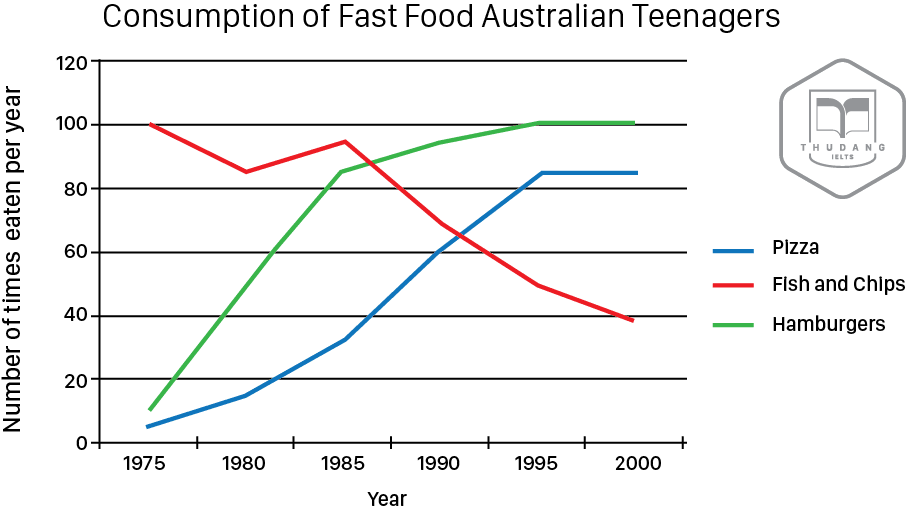
Prompt: The graph below shows the consumption of three types of fast food by Australian teenagers between 1975 and 2000.
Line graph showing fast food consumption by Australian teenagers 1975-2000 (Hamburgers, Pizza, Fish and Chips)
Line Graph: Consumption of Fast Food by Australian Teenagers (times per year)

Model Answer (Band 8 Analysis)

The line graph illustrates the changes in the amount of fast food consumed by teenagers in Australia over a twenty-five-year period starting from 1975.

Overview:
Overall, there was a significant increase in the consumption of hamburgers and pizza, while the popularity of fish and chips saw a steady decline. By the end of the period, hamburgers had become the most preferred fast food among Australian adolescents.

Body Paragraphs:
In 1975, fish and chips was the most popular choice, with teenagers eating it 100 times per year. However, this figure dropped consistently, reaching a low of just under 40 times by 2000.

Conversely, the consumption of hamburgers started at a modest 10 times per year but rocketed to approximately 85 times by 1985. It continued to rise, albeit more slowly, peaking at 100 times per year at the end of the period. Similarly, pizza consumption grew from roughly 5 times a year in 1975 to 82 times a year by 2000, overtaking fish and chips in the late 1980s.

4. Practice Task 2: The Table

Prompt: The table below gives information about the underground railway systems in six cities.
Table showing underground railway systems in six cities: opened date, route km, passengers per year
Table: Underground Railway Systems in Six Cities (Date Opened, Route Length, Annual Passengers)

Model Answer (Band 8 Analysis)

The provided table compares six city underground railway systems based on their age, total route length, and annual passenger volume.

Overview:
It is clear that the oldest systems are generally the most extensive in terms of track length. However, the highest passenger numbers are found in the Asian cities, specifically Tokyo, regardless of the system's age.

Body Paragraphs:
London has the oldest and most expansive network, opening in 1863 and covering 394 kilometers. Despite its size, it serves significantly fewer passengers (775 million) than the Paris Metro, which has only 199 km of track but handles 1,191 million commuters annually.

The Tokyo system, opened in 1927, is the busiest among the six, serving 1,927 million passengers per year despite having a mid-sized route of 155 km. In contrast, the newer systems in Washington DC and Kyoto are much smaller. Kyoto's railway is the most limited, with only 11 km of track and a yearly ridership of 45 million, which is the lowest figure shown in the table.

5. Common Pitfalls to Avoid

  • Over-reporting: You don't need to list every city or every year. Group the "minor" data points.
  • Mechanical Writing: Avoid starting every sentence with "The number was..." Try using "A total of..." or "The figure stood at..."
  • Giving Opinions: Never explain why you think the data changed. Stick to what is visible on the page.

Ready to Practice?

Write your own response to one of the tasks above and compare it with the model answers!

Submit Your Essay for Feedback

Post a Comment

0 Comments